Last updated: August 23, 2026
Sooner or later you find the two models sitting next to each other on the same brand page, with the same motor, the same fan and the same regulator. One has a small steel cylinder bolted underneath and costs meaningfully more. Master Airbrush sells exactly this pair as the TC-320 and the TC-326T, and the question of whether that cylinder is worth it comes up in every hobby forum, every month.
The honest answer is that a tank does not make your airbrush spray better. It makes it spray the same from the first second of a pass to the last, and it changes how often the motor has to run. Whether either of those is worth paying for depends entirely on what you paint and where the compressor sits.
This article contains affiliate links. If you buy through them, we may earn a commission at no extra cost to you. Learn more.
Quick Answer
Do you need an airbrush compressor with a tank?
- You do if you prime or basecoat in long runs, or if you lay smooth blends across large surfaces.
- You do if the motor noise is the problem, because a tank model runs in bursts instead of continuously.
- You probably do not for short detail sessions on single models at low pressure.
- A tank also collects water, so it needs draining. That is a feature, not a nuisance.
Bottom line: a tank buys flat pressure and a resting motor. It buys nothing at all for a painter who sprays in two minute bursts.
What the Tank Actually Does
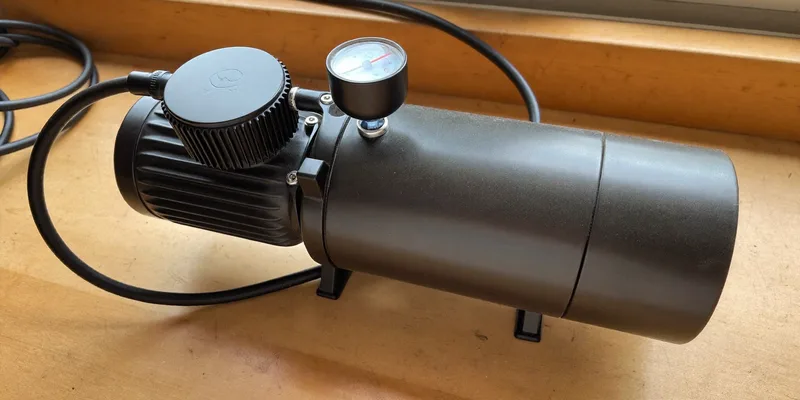
It stores compressed air so that you spray from a reservoir instead of directly from a piston. The motor fills the tank to its cut-out pressure and stops. You paint from stored air at whatever the regulator is set to, and the motor only restarts when the tank falls to its cut-in pressure. Nothing about the airbrush changes.
Two consequences follow. The air arriving at the brush is completely smooth, because it is coming out of a steel can rather than off the top of a piston stroke. And the motor spends most of the session switched off, which is why owners describe tank models as quieter even when the running noise is identical.
Why a Tankless Compressor Pulses
A tankless unit pumps straight into the hose. Each stroke of the piston sends a small pressure spike down the line, and what arrives at the nozzle is a rapid ripple rather than a flat stream. Manufacturers damp it with a coiled hose or a small chamber, which helps, but the ripple is inherent to the design.
On primer, on basecoats and on anything textured, you will never see it. On a long smooth gradient across a tank hull or a large cloak, it shows as faint banding in the direction of travel. If you are already chasing that symptom, our guide to airbrush compressor pulsing works through the other causes first.
The Coiled Hose Half Fix
A long coiled hose adds volume between the pump and the brush, which softens the pulse noticeably. It is not the same as a tank, but it costs far less and it also gives the air time to cool, which helps with moisture. Lengths and fittings are in our airbrush hose guide.
TC-320 Against TC-326T, Inside One Brand
This is the cleanest version of the decision because everything else is held constant. Master Airbrush lists both as Cool Runner II dual fan units with the same regulator, gauge and water trap. The TC-326T adds a three liter tank, and Master rates the tank model at 0.8 CFM. The brush, the hose and the fan are the same.
So the money buys the tank and nothing else. That makes the choice easy to reason about: if the tank solves a problem you actually have, pay for it. If pulsing has never bothered you and the motor noise does not reach anyone else in the house, the tankless model is the same compressor with less to store and less to drain.

How Big a Tank Is Big Enough
Small. Hobby tanks run from around two to three liters on desktop models, and Paasche fits the D3000R with a three quarter gallon tank. A single airbrush at hobby pressure draws so little air that even the smallest of these gives you a long stretch of spraying before the motor wakes up.
Bigger tanks mean longer silent runs and longer refills, not better spray. The reason to want more volume is running two brushes, or spraying at higher pressure through a larger nozzle, where a two liter tank empties faster than you would like.

The Tank Is Also a Water Trap
Air leaving a compressor is hot and humid. Inside a tank it slows down, cools and drops part of its moisture as liquid, which then sits at the bottom instead of traveling down your hose. That is why tank models come with a drain screw underneath, and Paasche notes in the D3000R manual that water accumulates in humid conditions and the tank should be drained.
Open the drain at the end of a session, let it hiss, close it. Skipping it for a year is how tanks rust from the inside. This does not replace a proper trap near the brush, and our guide to the moisture trap for airbrush explains why the placement matters.
Tank Against Tankless, Side by Side
The table sets the two out on the four points that actually differ. Everything not listed here is the same on both, which is precisely why the decision confuses people.
| Point | Tankless | With tank | Who should care |
|---|---|---|---|
| Pressure delivery | Faint pulse from each stroke | Completely flat | Anyone laying long smooth blends |
| Motor behavior | Runs the whole time | Fills, stops, rests | Apartments and evening painting |
| Moisture | Trap does all the work | Tank drops water first, then the trap | Humid rooms and summer sessions |
| Practicalities | Light, small, nothing to drain | Heavier, needs a drain habit | Anyone carrying the setup around |
When Tankless Is the Right Answer
When you paint single models in short sessions at low pressure, when the compressor lives on a shelf you have to lift it off, or when you are buying your first setup and would rather put the difference into paint and a decent brush. None of those painters are being short changed by a tankless unit.
It is also the right answer if portability is the point. A tank adds weight and bulk to something you intend to carry, and our portable airbrush compressor guide covers that side of the trade.

The Premium Version of the Same Idea
Iwata builds the tank argument into the Power Jet Pro, which the company lists with a two liter tank, two regulators so two workstations can run from one unit, and its Smart Technology auto stop. It is the same physics as a hobby tank model, executed with better fittings and a longer expected life.
Whether that is money well spent is a separate question, and it turns mostly on how many hours a year the compressor runs. Our guide to the Iwata airbrush compressor range goes through what the price step does and does not buy.

Frequently Asked Questions
Will a tank stop my airbrush spitting? Only if the spitting is moisture. A tank cools the air and drops water before it reaches the hose, which helps a lot in a humid room. If the spitting is dried paint on the tip or a loose nozzle, a tank changes nothing. Our guide to airbrush spitting sorts the causes.
How often should I drain the tank? At the end of any session where you sprayed for a while, and always before storing it for weeks. It takes five seconds. In a dry room you may get almost nothing out; in a humid basement in August you will be surprised.
Does a tank make the compressor quieter? The peak noise is the same, but you hear it far less often, because the motor is off while you spray. For most people that is the difference that matters, though it also means the motor kicking in is a sudden noise rather than a constant one.
Can I add a tank to a tankless compressor later? In principle yes, with an auxiliary air tank and the right fittings, and some people do it with a small portable tank. It is fiddly, and the pressure switch on a hobby compressor is not designed to manage it, so most people who go that route find it more trouble than buying the tank model.
Is a bigger tank always better? No. Past a couple of liters you are buying longer gaps between refills, not better spray quality. Weight, footprint and the noise of a bigger motor filling it all go the wrong way, and desktop hobby painting never asks for that volume.
The Bottom Line
A tank buys two specific things: air that arrives perfectly flat, and a motor that spends the session switched off. If you prime in batches, blend across large surfaces, or paint in a room where a running motor is a problem, those two things are worth the step up and the drain habit that comes with them. If you paint single models in short bursts, the tankless version of the same compressor is not a compromise. Read next: how to pick an airbrush compressor and what quiet actually means on a listing.