Last updated: August 23, 2026
It always happens at the same point in the session. You have been spraying for half an hour, the basecoat is going down evenly, and then a clear droplet lands in the middle of a cloak and spreads. Not paint. Water. It runs, it lifts the coat underneath, and the only fix is to let it dry and redo the panel.
This is the most avoidable problem in airbrushing and one of the most common, because the compressor that came in your kit almost certainly has a trap in the least effective position on the entire setup. Before you buy anything, there are three free changes that fix most cases.
This article contains affiliate links. If you buy through them, we may earn a commission at no extra cost to you. Learn more.
Quick Answer
How do you stop water coming out of an airbrush?
- Drain the tank first. On a tank compressor this alone solves a lot of cases.
- Use a longer hose. Air that travels further cools further, and cool air drops its water in the line instead of on the model.
- Put a trap at the airbrush end, not only at the compressor, because air at the outlet is still warm.
- In a humid room, drying the room does more than any filter.
Bottom line: cool the air, then catch the water. A trap at the compressor alone is the weakest version of both.
Where the Water Comes From
Out of the air in your room. Compressing air squeezes it into a smaller volume, and that air cannot hold as much water vapor as it did, so the excess turns into liquid. The compressor also gets hot, warm air holds more moisture, and the moment that warm wet air cools down inside your hose it drops the difference.
Nothing about that is a fault. Every compressor does it, expensive ones included. The difference between setups is where the water condenses: in a trap you can drain, or on your model.
Why It Gets Worse Later in a Session
Because the compressor warms up. Cold, the unit passes relatively dry air. After twenty or thirty minutes the pump is hot, the air leaving it is hot, and the temperature gap between the outlet and your hose is at its widest. That is exactly when the first droplet appears.
The Free Fixes, in Order
Work through these before buying anything, because several cost nothing and two of them are more effective than an extra filter. Most water problems are solved somewhere in this list.
First, drain the tank if you have one. Paasche notes in the D3000R manual that water accumulates in humid conditions and the tank should be drained with the screw underneath. Second, use a longer hose and let the air cool before it reaches the brush. Third, move the compressor out of the warmest, dampest corner of the room and off the floor if the floor is cold concrete.
Why Trap Placement Beats Trap Size
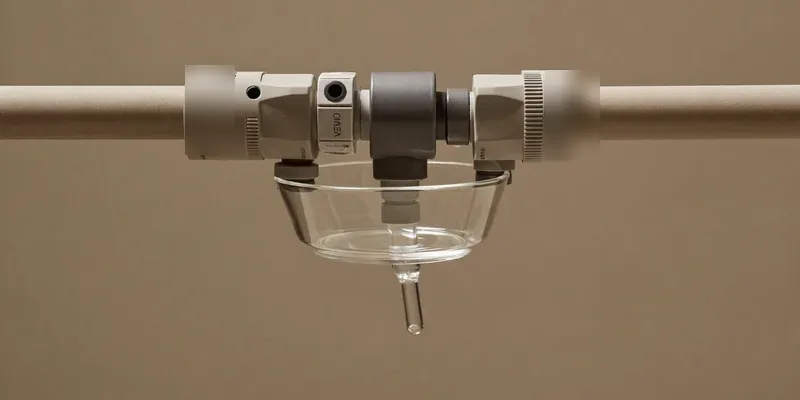
A trap works by letting warm wet air slow down, cool, and drop its water into a bowl. That means it needs cool air to work with. A trap screwed directly onto the compressor outlet is handling air at its hottest, when most of the moisture is still vapor, so it catches a fraction of what is there.
Put a second, small trap at the far end of the hose, right before the airbrush, and the air arriving there has already cooled along a few feet of line. That is where the water actually condenses, and that is where you want the bowl. Keeping both is the standard setup, not one instead of the other.

The Longer Hose Is the Underrated Fix
A hose is a heat exchanger. Every extra foot gives the compressed air more time to shed heat into the room, and cooler air arriving at the trap means more of the water ends up in the bowl. Going from a short kit hose to a longer braided one often changes the problem entirely.
It also lets you move the compressor further away, which helps with noise, and gives you slack so the hose does not tug at the brush while you work. Pressure loss over that distance at hobby settings is not something you will notice. Fittings and lengths are in our airbrush hose guide.

What Each Piece of Kit Actually Does
The pieces overlap and the listings blur them together, so it helps to see what each one contributes and where it belongs in the line.
| Part | Where it goes | What it does | Limitation |
|---|---|---|---|
| Tank with drain screw | On the compressor | Cools and collects water first | Useless if you never drain it |
| Trap on the outlet | Compressor outlet | Catches the coarse moisture | Air is still warm here |
| Inline trap | Between hose and airbrush | Catches what condensed in the line | Small bowl, needs emptying |
| Longer hose | Whole run | Cools the air before the trap | Slight pressure loss, rarely noticed |
Humid Rooms and Summer Sessions
If the air in the room is wet, every filter downstream is fighting a losing battle. Basements, garages in humid climates and any room in the middle of a muggy August will push more water into the line than a small bowl can reasonably catch.
The honest answer there is to dry the room rather than the line. A dehumidifier running in the space where you paint reduces the moisture at the source, and it also makes the room a better place to paint in generally, since paint behaves more predictably. This is the one case where the equipment answer sits outside the airbrush setup entirely.
When the Tank Is the Trap
A tank compressor does much of this work for you. Air sits in the steel cylinder, cools, and drops water to the bottom where the drain screw is. That is why tank models tend to have fewer moisture complaints, provided the owner actually opens the drain.
If you are already shopping for a compressor and moisture is your recurring problem, that is a reason to look at the tank versions rather than adding filters to a tankless unit. Our guide to the airbrush compressor with tank covers the rest of that trade.

Maintaining the Trap You Have
Traps are not permanent solutions that sit there forever. The bowl fills, and once it is full the water starts moving on down the line as if the trap were not there. Some have a manual drain valve, some you unscrew, and either way it is a ten second job at the end of a session.
Filter elements inside a trap also load up with dust and oil over time and stop separating properly. If yours has a replaceable element, replace it occasionally. If it has a felt or bronze insert, blow it out. A trap you have never emptied is decoration.

Frequently Asked Questions
My airbrush suddenly sprays water. What do I check first? Drain the tank, then look at how long you had been running. If it started after twenty minutes of spraying, it is condensation and the fix is cooling and trapping the air. If it started immediately and the spray is inconsistent, it may be a loose nozzle instead. Our guide to airbrush spitting separates the two.
Is a moisture trap the same as an air filter? Not quite. A trap separates liquid water and heavy particles by slowing the air and spinning it. A filter element catches finer particles and some oil mist. Most hobby units are both in one housing, which is fine, but they need emptying and occasionally replacing.
Where exactly should the inline trap go? As close to the airbrush as you can put it without making the brush awkward to hold. Screwed directly onto the airbrush inlet is common, and it is the coolest point in the system. Some people find the extra weight at the brush annoying and put it a foot back along the hose instead.
Can water in the line damage the airbrush? Not the airbrush itself, but it ruins the paint job and it can start corrosion inside a steel tank over years. The bigger risk is to your patience: water spots on an almost finished model are the kind of thing that puts people off the hobby.
Do I still need a trap with a tank compressor? Yes, though you will catch less in it. The tank does the coarse work and the drain screw removes it, but air leaving a tank is still saturated and will keep condensing as it travels. Keep the trap and keep draining the tank.
The Bottom Line
Drain the tank, lengthen the hose, and put a small trap at the airbrush end where the air is coolest. Those three changes fix most water problems and only one of them costs anything. If you paint in a genuinely humid room, dry the room rather than adding a third filter, because no bowl in the line can out work the air it is given. Read next: why an airbrush spits and how to pick an airbrush compressor.