Last updated: August 23, 2026
The hose is the part nobody researches and everybody eventually replaces. It arrives in the kit, it is too short, it is stiff enough to drag the airbrush sideways when you set it down, and the fitting on one end does not match the compressor you bought six months later. None of that is expensive to fix, and all of it makes painting more pleasant.
It is also the part that quietly solves two other problems. A longer hose lets warm air cool before it reaches the brush, which cuts water spots, and it lets the compressor sit further away, which cuts noise. For the price of a hose, that is a good trade.
This article contains affiliate links. If you buy through them, we may earn a commission at no extra cost to you. Learn more.
Quick Answer
Which airbrush hose should you buy?
- Braided over plain vinyl. It stays flexible, resists kinks, and does not go stiff in a cold room.
- Longer than the kit hose. Six to ten feet gives you slack, cooler air and a compressor you can move away.
- Check the thread. Most airbrushes and hoses are 1/8 inch BSP; Paasche and shop gear use 1/4 inch NPT.
- Add a quick disconnect if you swap brushes, so you are not unscrewing fittings mid session.
Bottom line: braided, longer than you think, and buy the adapter at the same time as the hose.
What the Hose Has to Do
Carry air without leaking, without kinking, and without fighting your hand. That sounds trivial until you have used a stiff vinyl hose that has taken a set in the box and now wants to lift the airbrush off the holder every time you put it down. A hose you do not notice is the goal.
Everything else is secondary. Air at hobby pressures moves happily through any reasonable bore, so internal diameter is not something you need to shop for. Flexibility, length and fittings are the whole decision.
Braided, Vinyl or Coiled
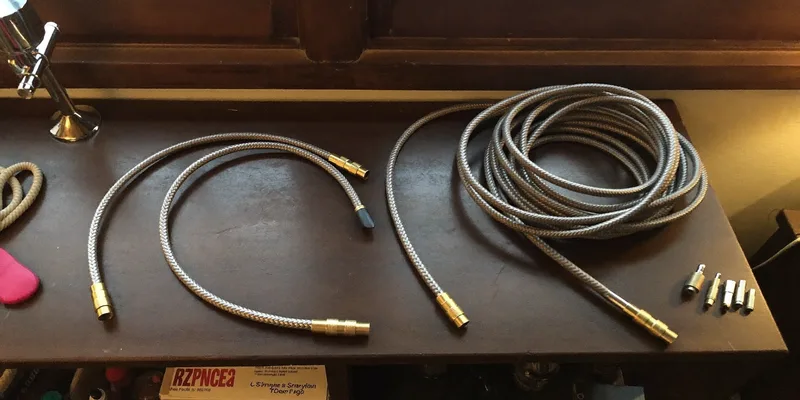
Braided hose is a rubber or PVC core wrapped in a woven sleeve. It is flexible, it resists kinking, and it stays that way in a cold room, which is why most people end up with one. Plain vinyl is cheaper and lighter, and it stiffens with age and cold. Coiled polyurethane hose retracts out of the way and adds volume to the line.
The coiled type has a specific advantage: the extra internal volume damps the pulse from a tankless compressor and gives the air more time to cool. Some people find the constant gentle pull annoying, so it suits a bench where the compressor sits close and you want the hose off the table.

How Long Should It Be
Longer than the hose in the kit. Six feet is the common default and it is fine for a compressor under the table. Ten feet lets you put the unit on the floor across the room, in a cupboard with the door ajar, or anywhere else it stops being the loudest thing in the house.
There is no meaningful pressure penalty at hobby settings over these distances, and there are two side benefits: cooler, drier air arriving at the brush and enough slack that the hose never tugs. The only real cost is a hose that has to be coiled and put away.
The Cooling Bonus
Warm compressed air carries moisture, and it drops that moisture when it cools. A longer run means it cools in the hose, where a trap can catch it, rather than at the nozzle. Our guide to the moisture trap for airbrush explains why that placement matters.
Fittings: the Part That Trips People Up
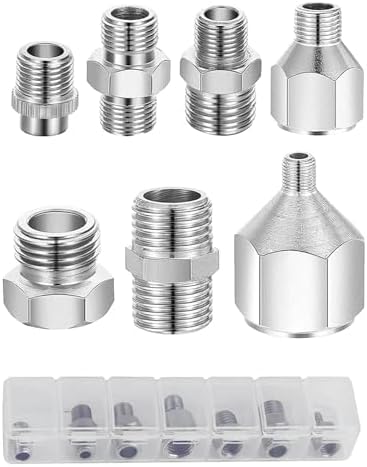
Most airbrushes and most airbrush hoses use a 1/8 inch BSP thread, which is the effective standard in this hobby. Iwata and Badger use it. Paasche uses 1/4 inch NPT, and general shop equipment and many compressor outlets are NPT too, so a mixed setup needs an adapter.
Adapters are small, cheap and easy to forget when ordering, which is how a new hose ends up sitting in its bag for a week. Buy a small adapter set with the hose. Hose kits sold as compatible with multiple brands usually include the common conversions in the box.
Which Hose Setup for Which Bench
The table pairs a bench situation with the hose arrangement that suits it and the part people forget to order.
| Situation | Hose to use | Why | Easy to forget |
|---|---|---|---|
| Compressor under the table | Six foot braided | Enough slack, nothing to trip over | Thread adapter for your brush |
| Compressor across the room | Ten foot braided | Quieter, cooler and drier air | Somewhere to coil it after |
| Tankless unit that pulses | Coiled polyurethane | Extra volume softens the pulse | The gentle pull on the brush |
| Two brushes on one compressor | Manifold plus two hoses | No unscrewing between colors | Blanking plug for unused ports |
Quick Disconnects
A quick disconnect is a two part coupler: one half stays on the hose, the other stays on each airbrush. Swapping brushes becomes a push and a click instead of unscrewing a fitting with paint on your fingers. If you run a primer brush and a detail brush, this is the accessory that pays for itself fastest.
Two cautions. Cheap couplers can leak slightly, which you will hear as a hiss, and they add a small amount of weight and length at the brush end. Buy a set with spare male ends so every brush can wear one permanently.

Running More Than One Airbrush
A manifold splits the compressor output into two, three or four ports, each with its own valve. You can leave a brush loaded with primer and another with a detail color and switch by opening a valve. It is a genuine workflow upgrade for anyone painting in batches.
Air supply is the limit. Spraying two brushes at once will out breathe a small tankless compressor, so treat the manifold as a way to keep brushes connected rather than to use them simultaneously. If you want two people spraying at once, that is where a tank and a larger unit come in, as our guide to tank compressors covers.

Leaks, Tape and the Hiss You Learn to Hear
Threaded air fittings need sealing. Most come with a rubber washer or a tapered thread that seals metal to metal, and when they do not, a couple of turns of PTFE tape on the male thread solves it. Wrap in the direction the fitting turns so the tape does not unwind as you tighten.
You will learn the sound of a leak: a constant faint hiss with the compressor on and the trigger closed, and a tank compressor that cycles on every few minutes even though you are not spraying. Soapy water on each joint finds it in under a minute.
Frequently Asked Questions
Does a longer hose reduce my pressure? Not enough to matter at hobby pressures over the lengths people use. The pressure drop across ten feet of airbrush hose at 20 PSI is small, and you set the regulator to compensate anyway. The benefits in noise and dry air outweigh it easily.
What thread does my airbrush use? Most likely 1/8 inch BSP, which is what Iwata, Badger, Harder and Steenbeck and most Amazon brands fit. Paasche uses 1/4 inch NPT. If the hose end almost threads on and then binds, you have the wrong standard, not a cross threaded fitting, so stop and check.
Can I use a garden or fish tank hose? No. Air hose has to hold pressure without ballooning or splitting and needs proper threaded ends. Soft tubing pushed onto a barb will come off under pressure, usually while your hand is holding a loaded airbrush.
Why does my hose smell of solvent? Because cleaner has been drawn back into it, which normally means you have been backflushing too hard with the cap on and pushing fluid down the air line. Ease off, and check that the airbrush is not leaking air backward past a worn O ring. Our maintenance guide covers O rings.
Should I leave the hose connected between sessions? It does no harm, and it saves wear on the threads from repeated fitting and removal. Do release the pressure and drain the tank, and try not to leave the hose sharply bent over the edge of a table, which is where vinyl takes a permanent kink.
The Bottom Line
Buy braided, buy longer than the kit hose, and order the thread adapter at the same time so the package is usable the day it arrives. Add a quick disconnect if you own more than one brush and a manifold if you paint in batches. It is the cheapest part of the setup and it fixes noise, water and handling all at once. Read next: how to pick an airbrush compressor and the moisture trap fix.