Last updated: August 23, 2026
Portable means two different things in this category and the listings never tell you which one you are looking at. Sometimes it means a mains powered compressor small and light enough to carry to a club night in a bag. Sometimes it means a battery unit that clips onto the airbrush itself. Those are not variations on a theme, they are different machines with different limits.
Most people searching for a portable compressor want the first kind: something that lives in a cupboard, comes out onto the kitchen table for an evening, and occasionally travels to a friend’s house or a convention build table. That is a solved problem, and it does not require giving up a regulator or a moisture trap.
This article contains affiliate links. If you buy through them, we may earn a commission at no extra cost to you. Learn more.
Quick Answer
What makes an airbrush compressor genuinely portable?
- Weight you can carry one handed with a bag in the other. Hobby units run from roughly seven pounds upward.
- A handle or a shape you can actually grip, not a bare steel box.
- A regulator and trap that stay attached, so setup at the other end is plugging in a hose.
- Mains power. Battery units trade pressure for freedom and that trade is rarely worth it.
Bottom line: buy a light mains compressor with the fittings built on. Portable should mean easy to carry, not weaker.
Portable Usually Means Light and Mains Powered
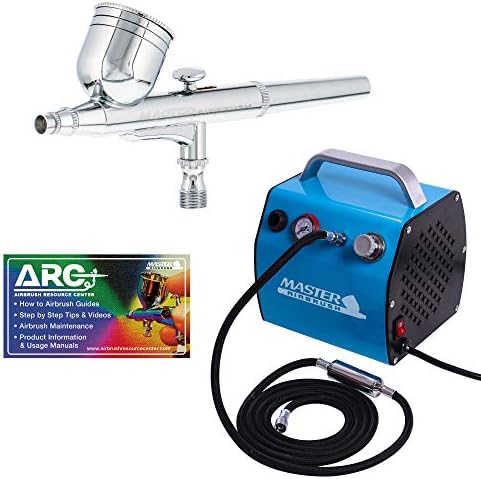
The tabletop hobby compressor is already a portable machine by any sensible definition. Sparmax lists the TC-501N at seven pounds and Iwata lists the Smart Jet Pro at fourteen, and both fit in a shopping bag. Compared with a shop compressor, these are luggage, and they still deliver a regulator, a gauge and a trap.
So the practical question is not whether a compressor is portable, it is which corners the manufacturer cut to make it small. The usual casualties are the tank, the cooling fan and the regulator, in that order, and only one of those genuinely matters for short sessions away from home.
What You Give Up by Going Small
The tank goes first, because it is the heaviest part. That brings back the faint pulsing that tankless units have, which for priming and basecoats at a club table is irrelevant. Then the cooling fan goes, which limits how long you can run before the unit gets hot, and a convention session is rarely long enough to reach that limit.
What you should not give up is the regulator and the moisture trap. Without a regulator you cannot set a working pressure, and without a trap you are one humid afternoon away from a water spot on a finished model. Our guide to the airbrush pressure regulator covers what to look for.

Battery Units Are a Different Category
Cordless compressors clip to the airbrush or sit in a small brick and run from a rechargeable pack. They are genuinely convenient and they are genuinely limited, because pressure falls as the battery drains and the fall is gradual enough that you do not notice until the spray pattern changes mid model.
That makes them workable for priming and basecoating and unreliable for detail, and the Amazon listings in that search are a difficult place to shop because most of the top sellers are cheap handheld units built for something other than models. The honest version of that argument is in our guide to the cordless airbrush.
Carrying It Without Breaking It
Compressors do not enjoy being tipped, dropped or carried by the hose. The parts that break in transit are the gauge, the regulator bowl and the plastic fittings, all of which stick out and all of which are easy to snap against a door frame.
Unscrew the regulator assembly and pack it separately if it comes off easily, or wrap it. A cheap tool bag or a plastic crate protects everything better than carrying the unit loose, and it also gives you somewhere to keep the hose, the adapters and the cleaning pot so that arriving somewhere does not turn into an inventory check.
What Portable Costs You in Practice
Each thing a small compressor leaves out has a consequence you will meet at some point. The table pairs the omission with when it will actually bite, so you can decide which ones you can live with.
| Left out | What you lose | When it bites | Workaround |
|---|---|---|---|
| Tank | Flat, pulse free air | Long smooth blends | Coiled hose softens the pulse |
| Cooling fan | Long run tolerance | Priming a batch in one go | Break the session into stretches |
| Regulator with gauge | Setting a pressure at all | Immediately | Do not buy without one |
| Moisture trap | Dry air | Humid rooms, summer | Inline trap at the brush end |
Painting Somewhere That Is Not Your Table
A club night, a friend’s kitchen or a convention build table has two constraints your own bench does not: you cannot spray toward other people, and you cannot leave a mist hanging in a shared room. Bring a booth or do not spray, and if the venue has no window, keep it to priming outdoors and detail work indoors.
Our guides to the portable spray booth and to airbrush ventilation cover the setup side. The short version is that a folding booth packs down to the size of a laptop bag and makes you a welcome guest rather than a problem.

Storage Is the Real Reason Most People Want Small
Not travel. Most painters who search for a portable compressor are not going anywhere; they are painting on a table that has to be a dining table again by seven. A unit that goes back in a cupboard in one movement gets used far more than a good compressor that lives behind a door.
Buy for that, and the priorities change slightly: handle, short cable that coils, and fittings that survive being put away every session. Our airbrush holder guide covers the other half of packing down quickly, and the paint station piece covers a bench that folds away with everything still on it.

Frequently Asked Questions
Is a mini compressor powerful enough for miniatures? Yes. Miniature work happens at low pressure through a small nozzle and uses very little air. Even the smallest hobby units supply more than a single gravity feed brush needs. Power is almost never the limit; steady pressure and dry air are.
Can I run a portable compressor from a car or a power bank? Not a mains one, unless you add an inverter big enough for the motor’s startup surge, and small inverters usually are not. If you genuinely need to paint away from an outlet, that is the one situation where a battery unit makes sense despite its limits.
Do small compressors overheat? They can, if you run them continuously for a long stretch, because there is little mass to absorb the heat and often no fan. For normal hobby sessions with pauses to mix and mask, they run well within themselves. Give one a rest if the casing gets hot to the touch.
Will a smaller compressor pulse more? Usually yes, because small means tankless. The pulse is invisible on primer and basecoats and shows as faint banding on long smooth passes. A coiled hose between compressor and brush adds volume and softens it noticeably.
What is the lightest setup that still works properly? A tankless unit in the single digit pound range with a regulator, gauge and trap attached, plus a braided hose. That combination fits in a bag, sets up in a minute, and gives up nothing you will miss on a model.
The Bottom Line
Buy a light mains compressor that keeps its regulator and trap, and let the tank and the cooling fan be the things you sacrifice for size. That covers the club night, the friend’s kitchen table and, far more often, the cupboard you have to put everything back into before dinner. Leave battery units for the situation where there is genuinely no outlet, and read the honest version first. Read next: how to pick an airbrush compressor and what belongs in a starter setup.