Last updated: August 23, 2026
An airbrush looks complicated and is not. It is a small air valve, a tapered needle sitting in a matching nozzle, and a passage that lets paint meet a fast moving stream of air. Everything else on the tool exists to let your finger control those three things at once.
Understanding the mechanism is genuinely useful rather than trivia, because almost every problem people have with an airbrush is one of these parts not doing its job. Once you can picture what is happening inside, sputtering, tip dry and bubbles in the cup stop being mysteries.
This article contains affiliate links. If you buy through them, we may earn a commission at no extra cost to you. Learn more.
Quick Answer
How does an airbrush work?
- Compressed air rushes past the tip of a nozzle and drops the pressure there.
- That pressure drop pulls paint out of the nozzle and shatters it into a fine mist.
- A tapered needle sliding in the nozzle decides how much paint can escape.
- The trigger opens the air valve when pressed down and pulls the needle back when drawn back.
Bottom line: an airbrush is an air valve, a needle and a nozzle, and every common fault is one of the three.
Atomization in One Paragraph
Atomization is the word for turning liquid paint into a cloud of droplets small enough to land as a smooth film. Air moving quickly past the paint outlet lowers the pressure there, paint is drawn into that fast stream, and the shear between moving air and still liquid tears it apart. Finer droplets mean a smoother coat.
How fine those droplets get depends on air speed, nozzle geometry and how thin the paint is. That is why a well thinned paint at moderate pressure looks smooth and a thick paint at the same pressure looks like sand.
Why Thinning Changes Everything
Thick paint resists being torn apart, so it leaves the nozzle in larger droplets that land as visible texture. Thin it down and the same airflow breaks it into a much finer mist. This is the physical reason that thinning is the first advice in every troubleshooting thread, and it is covered properly in our thinning guide.
The Parts, and What Each One Does
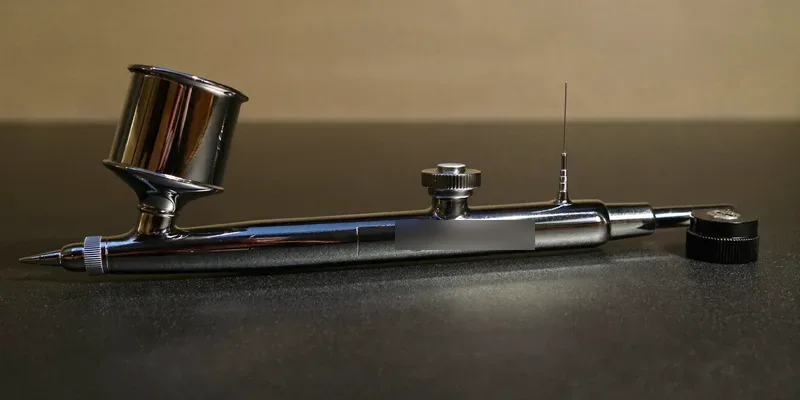
Six components do all the work. The air valve lets compressed air through when you press the trigger. The needle slides forward and back inside the nozzle. The nozzle shapes the air and paint at the tip. The crown cap protects the needle. The cup or bottle holds the paint. The body ties them together.
Everything you take apart during cleaning is one of those six, which is why disassembly is much less alarming once you know what you are looking at.
The Needle Is a Valve, Not a Brush
The needle tapers to a fine point and seats inside the nozzle to seal it completely. Pull it back a little and a small gap opens, letting a little paint through. Pull it back further and the gap widens. It is a variable valve, and it is the reason paint flow is continuous rather than on or off.
What the Trigger Is Doing
On a dual action airbrush the trigger does two independent jobs with one finger. Pressing down opens the air valve, so air flows and nothing else happens. Drawing the trigger back pulls the needle out of the nozzle, and paint begins to flow into the moving air. Release the trigger back forward and the paint stops; let it up and the air stops.
That sequence, air on, paint in, paint off, air off, is the whole technique. Reversing it is what produces the blob at the start of a stroke and the splatter at the end.
Single Action Brushes Split the Job
On a single action brush the trigger only opens air, and the needle position is set beforehand with a screw. You get consistent flow and no live control. Which type suits you is covered in our dual versus single action comparison.
How Paint Gets to the Nozzle
Two ways. A gravity feed airbrush has a cup on top, and paint simply falls into the passage, which means the air only has to atomize it. A siphon feed brush hangs a bottle below, and the low pressure at the nozzle has to lift the paint up a tube before it can atomize it, which takes more air pressure.
This is why gravity feed brushes work at the low pressures hobby painting prefers, and why siphon feed brushes sputter if you turn the pressure down too far.
Airbrush Versus a Spray Can
A spray can is a fixed system: fixed pressure, fixed paint, fixed pattern, and the pressure drops as the can empties. An airbrush separates every one of those variables and hands them to you. That is the real difference, and it explains both why an airbrush is more capable and why it takes longer to get a result.
| Aspect | Spray can | Airbrush | Consequence |
|---|---|---|---|
| Pressure | Fixed, falls as it empties | Set on a regulator | Airbrush handles thin coats |
| Paint choice | Whatever is in the can | Anything you can thin | Custom colors |
| Spray pattern | One fixed cone | Varies with the trigger | Fades and fine lines |
| Setup and cleanup | None | Several minutes each way | Cans win on speed |
Neither replaces the other. Plenty of modelers prime from a can and paint with an airbrush, which uses each tool where it is strongest.
Why the Mechanism Explains Your Problems
Sputtering usually means air is getting somewhere it should not, through a loose or cracked nozzle or a worn seal. Bubbles in the cup mean air is going backward up the paint passage, which is the same fault seen from the other end. Paint drying at the tip means the needle point is exposed and airflow is drying paint on it faster than new paint arrives.
Nothing on that list is mysterious once you can picture the air path and the paint path. Our troubleshooting guide maps symptoms to causes in one table.
Cleaning Follows the Same Logic
You clean an airbrush by clearing the paint path: the cup, the passage, the nozzle and the needle. A backflush pushes cleaner backward up the passage to loosen what is stuck in it. The routine in our cleaning walkthrough is simply that path, in order.
Frequently Asked Questions
What is an airbrush, in simple terms? A small paint sprayer where compressed air and a needle valve let you control how much paint comes out while you are spraying. It produces a much finer, more controllable mist than a spray can, at the cost of setup and cleaning time.
Does an airbrush need a compressor? It needs a source of steady compressed air, which in practice means a compressor. Propellant cans exist but empty quickly and lose pressure as they do, which is exactly the problem an airbrush is meant to solve.
What pressure does an airbrush run at? Much lower than most people expect for hobby work. Rather than copying a number, set a regulator, spray a test card and adjust until the paint lands smoothly. Our first session guide walks through finding it.
Why does paint come out in spatters instead of a mist? Usually paint that is too thick to atomize, pressure that is too low, or paint drying at the needle tip. All three interrupt the shearing action that turns liquid into mist.
What is a crown cap for? It protects the needle point from knocks while leaving the tip visible so you can see when paint is drying on it. Some painters remove it for very close detail work and accept the risk to the needle.
Is an airbrush hard to learn? The mechanism takes ten minutes to understand and the trigger coordination takes about one session. What takes longer is learning what your paint wants in terms of thinning and pressure, and that is mostly practice on scrap.
The Bottom Line
An airbrush passes fast moving air across a nozzle, which pulls paint out and shatters it into a fine mist, while a tapered needle controls how much paint can escape. The trigger opens the air when pressed and withdraws the needle when pulled back, which is why the sequence is always air first and air last. Keep that picture in mind and most faults become obvious. Read next: choosing an airbrush for miniatures if you are ready to buy, and nozzle sizes explained for the one specification that matters most.