Last updated: August 23, 2026
Paasche is the brand your local hobby shop has probably stocked since before you were painting. It is an American company that has been building airbrushes for more than a century, its model names are single letters, and its catalog assumes you know the difference between internal and external mix. None of that reads as modern, and none of it matters once the brush is working.
What does matter is that Paasche sells three completely different kinds of airbrush under one roof, and buying the wrong one is easy. An H is not a cheap Talon, and a Talon is not a fancier H. They are different machines for different jobs.
This article contains affiliate links. If you buy through them, we may earn a commission at no extra cost to you. Learn more.
Quick Answer
Which Paasche airbrush should you buy for models?
- Model work with shading and control: the Talon TG, gravity fed and double action.
- Flat coverage, primer and terrain on a budget: the H, single action and nearly unbreakable.
- Big volumes from bottles: the VL, double action and siphon fed.
- You need air as well: the D3000R pairs a tank and a moisture trap with the brushes.
Bottom line: old fashioned to look at, fully repairable, and the Talon is the one for miniatures and scale models.
The Three Families, Sorted
Paasche splits along two lines that matter more than model names: how the paint gets mixed with air, and how many things the trigger controls. The H is external mix and single action, the VL is internal mix, double action and siphon fed, and the Talon is internal mix, double action and gravity fed.
Those three descriptions tell you everything about who each brush suits. External mix means the paint and air meet outside the nozzle, which gives a coarser spray but almost nothing to clog. Internal mix gives the fine, even atomization that model painting wants.
Single Action Versus Double Action, Briefly
Single action means the trigger only controls air, with paint volume set by a knob beforehand. Double action means you press for air and pull back for paint, which is how you fade an edge or build a glaze. Our comparison of the two goes into when each one is enough.
The Talon TG: The Model Painter’s Paasche
The Talon is a double action, gravity feed airbrush, and Paasche’s own documentation lists interchangeable head sizes of 0.25mm, 0.38mm and 0.66mm, with the size two head at 0.38mm as the usual middle setting. That middle head is a sensible one brush answer for figures and scale models alike.
Being able to change heads matters more here than on brands that sell you a second brush instead. A 0.25mm head for freehand and a 0.66mm for primer and varnish turns one body into a small range, and all three are ordinary parts rather than special orders.

Where It Sits Against Iwata and Badger
Competitive, and less fashionable. The Talon does not attract the forum enthusiasm the Eclipse does, and owners tend to talk about it in terms of reliability rather than feel. If you want the most recommended brush, that is the Eclipse; if you want interchangeable heads at this level, the Talon has the edge.
The H Series: The Indestructible One
The H is a single action, external mix, siphon fed airbrush, and Paasche lists it with head sizes of 0.45mm, 0.65mm and 1.05mm. It is deliberately crude in the best sense: there is no fine nozzle, very little to block, and it will spray thicker paint than any internal mix brush tolerates.
For priming, base coating terrain, spraying varnish over a batch of models, or teaching a child to use an airbrush without fear, it is difficult to beat. What it will not do is shade, fade or feather, because the trigger does not control paint.

The VL and the Bottle Question
The VL is the double action, siphon fed classic: paint comes from a bottle under the brush rather than a cup on top, and heads are interchangeable. Siphon feed suits long sessions in one color, because a bottle holds far more than a cup and swapping bottles is quicker than washing a cup.
For miniature painting, where you change color every ten minutes and mix small quantities, that advantage inverts and becomes a nuisance. Our feed comparison covers exactly where the line falls.
The Paasche Range Compared
Three brushes and the compressor, with the manufacturer’s published head sizes and the job each is built for.
| Model | Action and feed | Heads listed | Best job |
|---|---|---|---|
| Talon TG | Double action, gravity | 0.25, 0.38, 0.66mm | Miniatures and scale models |
| H series | Single action, siphon, external mix | 0.45, 0.65, 1.05mm | Primer, varnish, terrain |
| VL | Double action, siphon | Three interchangeable sizes | Volume work from bottles |
| D3000R | Compressor with tank | Regulator and moisture trap fitted | Steady, dry air with auto shutoff |
How Paasche stacks up against the imports is covered in our brands comparison.
The D3000R Compressor
Paasche’s own compressor is unusual in the hobby bracket because it arrives complete. The company lists it as a one fifth horsepower piston unit with a three quarter gallon tank, a regulator and moisture trap already fitted, and an automatic shutoff, with a stated noise figure of 47 decibels and a working range that suits airbrush pressures.
A tank is what stops the pulsing that tankless kit compressors produce, and it also gives the air a chance to cool and drop moisture before it reaches your hose. If that is your problem, our guides to the compressor with a tank and the moisture trap explain why.

Parts and the Repair Culture
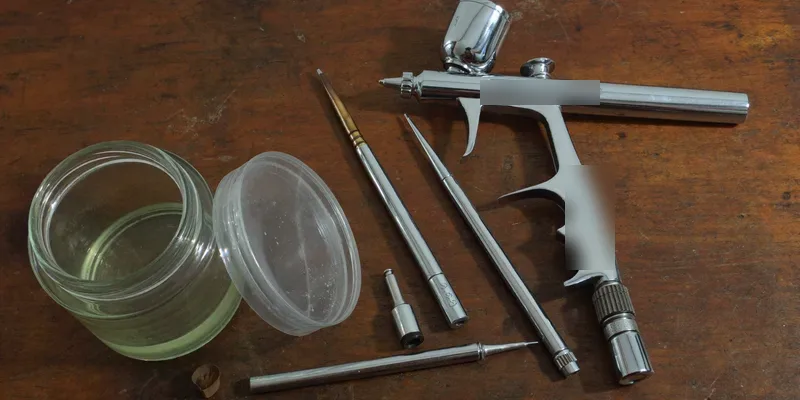
Paasche’s real argument is that nothing is disposable. Heads, needles, valves and even the small rubber parts are catalog items, diagrams are published for each model, and shops that have carried the brand for decades know the numbers. A twenty year old H can be brought back to life with parts ordered today.
That is worth weighing against the newer budget brands, where a cracked nozzle often means a new brush. Our page on replacement parts covers when a rebuild is the right call.
Frequently Asked Questions
Which Paasche is best for miniature painting? The Talon TG with the middle head. It is double action and gravity fed, which is what shading and glazing need, and the 0.25mm head is there when you want finer work. The H is excellent at priming and useless at fading an edge.
Is the Paasche H worth buying today? Yes, as a second brush. It sprays thick paint, primer and varnish that would clog a fine internal mix nozzle, it costs little to run, and it is nearly impossible to damage. As a only brush for figure painting it is the wrong tool.
Are Paasche parts easy to get? Unusually so. The company publishes parts diagrams and keeps model numbers alive for years, and hobby dealers stock the common needles and heads. That serviceability is the main reason painters stay with the brand.
Does the D3000R come with everything? Paasche lists it with a tank, a regulator and a moisture trap already fitted plus automatic shutoff, so the usual list of extra purchases is much shorter. You still supply the hose and the airbrush unless you buy a package.
What is external mix and does it matter? It means paint and air combine outside the nozzle rather than inside it. The spray is coarser and the atomization is not as fine, but there is very little to clog. For primer and varnish that trade is a good one; for smooth blends it is not.
Paasche or Badger for an American made brush? Both are made and supported in the United States and both are repairable. Badger’s Patriot has a simpler one piece head; Paasche’s Talon offers interchangeable head sizes. Read the Badger range guide and choose on that difference.
The Bottom Line
Paasche looks dated and behaves better than it looks. For miniatures and scale models the Talon TG is the brush, with three published head sizes that let one body cover freehand through to varnish. The H earns a place on the bench as the brush you reach for when the paint is thick and the surface is large, and the D3000R is one of the few hobby compressors that arrives with the tank, regulator and trap already attached. Read next: the full brand comparison, or how to choose a compressor if the air side is your weak point.