Last updated: August 23, 2026
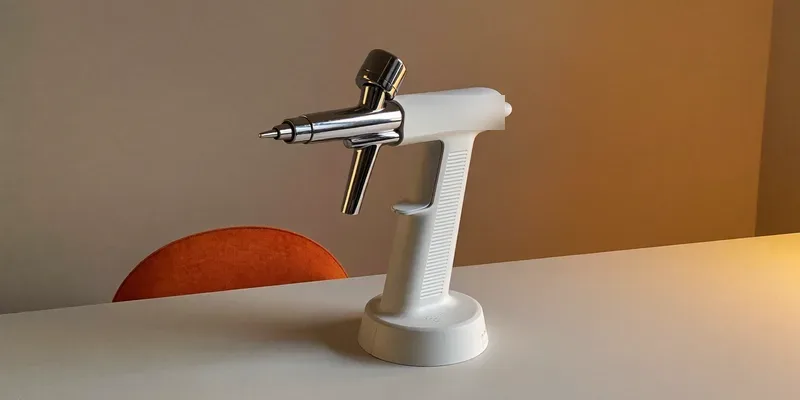
A cordless airbrush is an appealing idea and a difficult purchase. No compressor, no hose, no noise, no cable across the table: just a brush with a battery in the handle that you pick up and use. For a hobby where setup and cleanup already take longer than painting, that is a genuinely attractive promise.
The trouble is that the promise is easier to make than to keep. Air pressure is the thing that atomizes paint, a small battery pump is the weakest way to produce it, and a battery that is draining produces steadily less of it. This page is not a list of recommendations, because the honest reading of this category does not support one. It is an explanation of when the idea works and when it will disappoint you.
This article contains affiliate links. If you buy through them, we may earn a commission at no extra cost to you. Learn more.
Quick Answer
Is a cordless airbrush any good for miniatures and models?
- For priming and flat basecoats, sometimes. For fine detail, no.
- Pressure falls as the battery drains, and it falls gradually enough that you notice it in the finish first.
- The listings in this category are dominated by cheap handheld units built for a different use entirely.
- A small mains compressor with a long hose gives you the same freedom with none of the compromises.
Bottom line: buy this for convenience on rough work, never as your only airbrush. Owner ratings across the category are the weakest of any airbrush search.
What a Cordless Airbrush Actually Is
A conventional airbrush with a tiny battery powered pump built into the grip or into a small block that clips underneath. There is no separate compressor and no hose. You charge it over USB, fill the cup, and spray. Mechanically the front half is an ordinary airbrush with a needle, a nozzle and a trigger.
Everything that makes it different is in the air supply. A hobby compressor and a pump the size of a thumb are not comparable machines, and the gap shows up in exactly the places a painter cares about: how steady the pressure is, how long it holds, and how fine the mist is.
Pressure Is the Whole Problem
Atomization depends on air pressure being both adequate and constant. A cordless unit is fed by a battery whose voltage sags as it discharges, and reviewers who have used these describe exactly what you would expect: as the charge drops, the delivered pressure drops with it. Nothing warns you. The spray simply gets coarser.
That gradual fade is worse than a hard failure. If the brush stopped, you would charge it. Instead you finish a model that looks slightly grainy, blame your thinning, thin the paint further, and make it worse. The pressure was falling the whole time.
No Regulator, No Gauge
Most cordless units offer two or three preset levels rather than a regulator you can dial. You cannot set 14 PSI for a glaze and 24 PSI for primer, and you cannot verify what you are getting. Our guide to the airbrush pressure regulator explains why that control is the difference between predictable results and guessing.
What the Product Listings Are Telling You
Search the category and the picture is consistent. Owner ratings sit noticeably below what wired hobby brands manage, and the best selling items are inexpensive handheld devices sold for a completely different use, which happen to share the word airbrush. Neither of those signals appears in the searches for hobby brushes.
Read that as market information rather than as a verdict on any one product. When an entire category rates poorly and the volume sellers are not hobby tools, it means the engineering effort is going somewhere other than model painting, and the reviews reflect people discovering that.
Where Cordless Genuinely Works
Three situations. Priming and basecoating, where you want coverage rather than precision and a slightly coarser mist does no harm. Painting somewhere with no outlet, which is a real constraint at some club tables and in some rooms. And terrain or large scenery pieces, where you are covering area quickly and would otherwise be dragging a hose around.
In those uses the convenience is real and the compromise is invisible. Spray outdoors or in a booth, keep the battery topped up, and recharge before the finish starts to change rather than after. It is a second brush that earns its place, not a first one.
Where It Fails
Fine lines, glazes, freehand work, blends and anything where you are working close to the surface at low pressure. Those techniques depend on precise, stable pressure, and they are the reason people buy an airbrush rather than a rattle can in the first place.
It also fails as a long session tool. Battery life on these units is measured in tens of minutes of actual spraying, so an evening of painting means either a spare battery or a break to charge. For the same money and rather less frustration, a small mains compressor runs all night.
Cordless Against a Small Mains Setup
The comparison that matters is not cordless against a big compressor, it is cordless against the smallest sensible wired setup, because that is the real alternative.
| Point | Cordless unit | Small mains compressor | Why it matters |
|---|---|---|---|
| Pressure stability | Falls as the battery drains | Constant while plugged in | Decides whether detail work is possible |
| Control | Usually preset levels | Regulator and gauge | You can match pressure to the job |
| Session length | Limited by charge | As long as you like | An evening of painting without breaks |
| Freedom of movement | Total | Long hose gets close | The main reason to want cordless at all |
Going Cordless Does Not Change the Air in the Room
It is easy to treat a cordless brush as a casual tool you can use on the sofa, because there is nothing to set up. The paint mist is exactly the same mist. Whatever handling and ventilation the manufacturer specifies in the safety data sheet for your paint applies identically, and a cordless brush makes it more tempting to ignore.
Check the SDS for the paint you are spraying, follow what it says about ventilation and personal protection, and set up somewhere you would be willing to set up a corded brush. Our guides to airbrush ventilation and the airbrush spray booth cover how people handle that at a kitchen table.
What to Buy Instead
If freedom of movement is the goal, a light mains compressor and a ten foot hose delivers it for most benches, and keeps the regulator, the gauge and the moisture trap. Our guide to the portable airbrush compressor covers what to look for and what small units leave out.
If this would be your first airbrush, start with a conventional setup and add convenience later. The airbrush starter kit guide sets out what belongs in a first purchase, and airbrush brands compared covers where the sensible entry points are across the brands.
Frequently Asked Questions
Can a cordless airbrush prime a whole army? In stages, yes. Priming is forgiving of a coarser mist, so this is the job cordless units do best. Expect to recharge partway through, and watch for the finish getting grainier as the charge drops rather than pushing on to the end of the battery.
Why does my cordless airbrush spatter after a while? Most often falling pressure as the battery drains, sometimes paint drying on the tip because the mist is coarse and slow. Recharge first, then check the tip. Our guide to airbrush tip dry covers the second cause.
Do I still need to thin the paint? More than with a wired setup, not less. Lower and less stable pressure means the paint has to be thinner to atomize properly. Our guide to thinning acrylic paint for airbrush explains how to judge the consistency.
Are there any good cordless airbrushes for models? There are units that work acceptably for coverage work, and the category as a whole rates below the wired hobby brands. Treat any specific model as a convenience tool for priming rather than as a replacement for a compressor, and check current owner feedback before buying, since ratings move.
Is a cordless airbrush good for a beginner? Not as the only one. A beginner learning to control pressure, distance and thinning at the same time is better served by a setup where the pressure is one thing they can rely on. Learning on a tool that quietly changes underneath you makes a hard skill harder.
The Bottom Line
Cordless solves a real annoyance and creates a bigger one. As a second brush for priming, terrain and painting where there is no outlet, it is a reasonable thing to own. As your only airbrush, it will hold back exactly the work you bought an airbrush to do, and it will do it gradually enough that you blame yourself. Read next: portable airbrush compressor for the freedom without the compromise, and airbrush starter kit for a first setup that will not need replacing.