Last updated: August 23, 2026
Air comes out. Paint does not. You pull the trigger back further, you get nothing, then a sudden cough of half dried paint that lands as a blot. Ten minutes later you are sitting there with the nozzle in one hand and a cotton bud in the other.
Clogging is the reason people give up on airbrushing, and it is almost always caused by something upstream of the brush. Paint that is too thick, paint that was never properly mixed, or paint that dried inside the tool at the end of the last session. The tool itself is rarely the problem, and the fixes are free.
This article contains affiliate links. If you buy through them, we may earn a commission at no extra cost to you. Learn more.
Quick Answer
Why does my airbrush keep clogging?
- Paint too thick for the nozzle, in most cases. Thin it to the consistency of milk.
- Unmixed paint from a bottle that sat. Shake for a full minute before you thin.
- Dried paint left inside from last time. Backflush, then clean properly.
- Nozzle too small for the paint you are spraying, especially with primer and metallics.
Bottom line: fix the paint before you touch the brush. Reaching for a reamer first turns a paint problem into a parts problem.
What Is Actually Blocking
The gap between the needle and the inside of the nozzle, which is a fraction of a millimeter on a hobby brush. Anything that will not pass through that gap stops the paint: a clump of settled pigment, a flake of dried paint from the cup, a fiber from a paper towel, or a film that cured inside overnight.
A blockage is a particle problem, not a power problem, so pulling the trigger harder or turning the pressure up simply pushes the obstruction in tighter.
The Free Fixes, in Order
Run these in sequence and test after each. Every one of them costs nothing, and in most cases the blockage clears somewhere in the first three steps without the brush ever coming apart.
Backflush first: cover the crown with a finger and pull the trigger back so air pushes back into the cup and bubbles the paint. Then empty the cup, add cleaner and backflush again. Then pull the needle back a few millimeters, wipe it clean and reseat it gently. Then loosen and refit the nozzle, snug and never forced. Then thin the paint further and try again.
Do Not Reach for the Reamer Yet
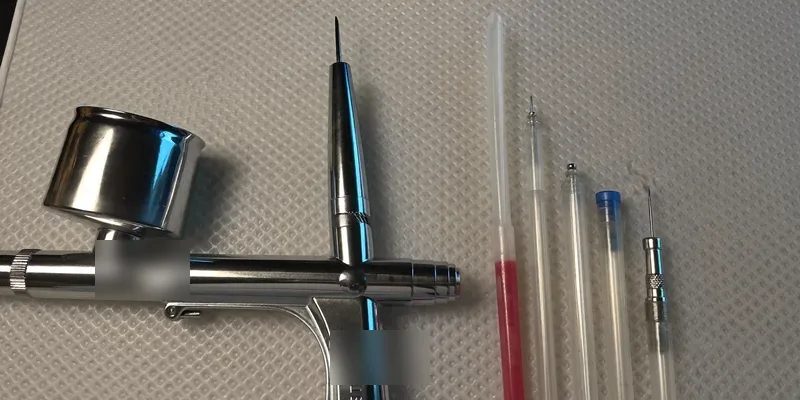
The fine wire reamer in a cleaning kit removes what a backflush cannot, and it also scores the inside of a nozzle if you push it in with any force. Save it for a blockage that survived cleaner and soaking, and use it with a light hand, straight in and straight out.
Cause One: The Paint Is Too Thick
This is the majority of cases. Bottle strength model paint is formulated for a brush, not for a nozzle a fraction of a millimeter wide, and even ranges sold as airbrush ready often want a little thinning for fine work. The target most painters use is the consistency of milk, thin enough to run off a stirrer in a stream rather than in drops.
Thinner is not the same as water. Water dilutes the binder as well as the pigment, so heavily watered paint goes on weakly and can lift later. A dedicated thinner keeps the binder in proportion, which is why it costs more than the tap and is worth it. Our guide to thinning acrylic paint for airbrush covers the ratios people actually use.

Cause Two: The Paint Was Never Mixed
Pigment settles. A bottle that stood on the rack since spring has heavy solids welded to the bottom and thin binder above them, and a few seconds of shaking does not touch the settled layer. What eventually reaches the airbrush is a slurry of clumps that no amount of thinning will make sprayable.
Shake for a full minute, inverted for part of it, ideally with a mixing ball in the bottle. If the paint still looks grainy on a stirrer, strain it through a fine mesh before it goes anywhere near the cup. Our miniature paint shaker guide covers doing this at scale.

Cause Three: Dried Paint From Last Session
Paint that cured inside the brush is a different animal. It does not clear with a backflush, it comes loose in flakes that block the nozzle repeatedly, and it usually means the last cleanup was a rinse rather than a clean. This is the clog that keeps coming back on the same brush.
The fix is a proper strip and soak with an airbrush cleaner, not more solvent through a blocked passage. Our guide to cleaning an airbrush covers how far to disassemble, and airbrush cleaner covers what to soak the parts in. Follow the ventilation guidance in the cleaner manufacturer’s safety data sheet while you work.

Cause Four: The Nozzle Is Too Small for the Job
A fine detail nozzle passes less material, so it is the first to block when you spray primer, metallics or a heavily pigmented color. Many people buy the smallest nozzle available thinking finer is better, then fight it every time they prime an army.
Matching the nozzle to the work removes a whole class of clogs. Detail nozzles for glazes and fine lines, a middle size as a general purpose default, a larger one for primer and coverage over big surfaces. Our airbrush nozzle size guide sets out which size suits which job.

Is There an Airbrush That Does Not Clog?
Searches for a brush that will not clog have grown sharply, and the answer is that no nozzle passes a particle wider than itself. What better brushes give you is easier clearing: a nozzle you can remove without special tools, parts that are actually available, and a design that lets you strip and reassemble it without damage.
Treat any listing that leans on that promise with suspicion, and judge a brush on how easily it comes apart instead. Gaahleri brushes get credit from owners for being modular and simple to clean, which matters far more day to day than any claim on the box.
Matching the Cause to the Fix
The pattern of when it blocks tells you which cause you have, so read the row that matches your case rather than working through everything.
| Pattern | Likely cause | Free fix | What actually helps |
|---|---|---|---|
| Blocks within a minute of starting | Paint too thick | Thin further, test on card | A proper thinner |
| Coarse specks, then a block | Unmixed or old paint | Shake a full minute, strain | Mixing balls, strainers |
| Same brush blocks every session | Dried paint inside | Strip, soak, backflush | Cleaner and a cleaning kit |
| Only with primer or metallics | Nozzle too small | Thin more, drop back a size | A larger nozzle or second brush |
Frequently Asked Questions
How thin should airbrush paint be? About the consistency of milk for general work, slightly thinner for glazes and fine lines. Test it on a card rather than on the model. If it beads or spatters it is too thick, and if it runs down the card and covers weakly it has gone too far.
Can I use water instead of thinner? For a light adjustment on water based acrylics, yes, and plenty of people do. Water dilutes the binder as well as the pigment though, so a heavily watered mix covers poorly and can lift when handled. A dedicated thinner is the better default.
Why does my airbrush clog only when I spray primer? Primer carries more solids than color paint, so it needs a larger nozzle, more thinning, or both. If you prime through a fine detail nozzle you will keep hitting this. Our airbrush primer guide covers what to spray it through.
Is it safe to run cleaner through the airbrush to clear a clog? It is standard practice, with the ventilation and handling that the cleaner manufacturer specifies in its safety data sheet. Spray into a covered cleaning pot rather than into the room, and do not soak seals in a solvent the maker warns against.
How often should I strip the brush completely? Only when a normal clean is not restoring the spray, or on a schedule of every few sessions if you paint often. Full strips carry their own risks, mainly bent needles and cracked nozzles, so they are maintenance rather than routine.
The Bottom Line
Nearly every clog is thick paint, unmixed paint, or paint that dried inside the brush last time, and all three are free to fix. Backflush, thin, shake and clean before you buy anything, and reach for the reamer only when a soak has already failed. If one nozzle size keeps blocking on primer, the honest answer is a bigger nozzle rather than a better technique. Read next: airbrush cleaner for the soak that clears old paint, and airbrush nozzle size for matching the tool to the job.