Last updated: August 23, 2026
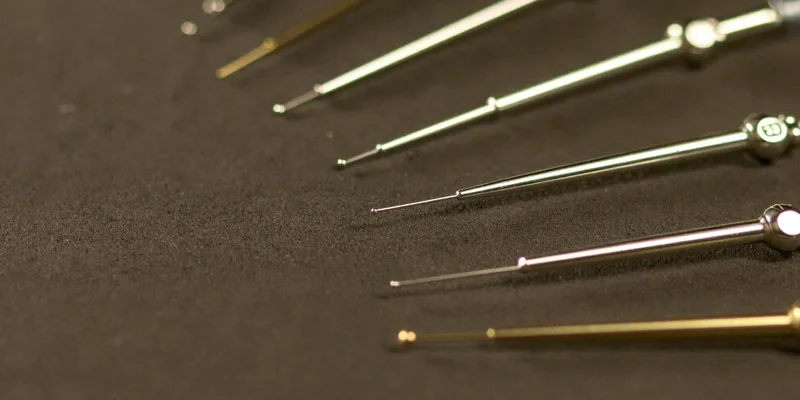
Two small parts decide almost everything about how your airbrush behaves, and both of them are consumables. The needle is a tapered steel rod that slides in and out of an opening barely wider than a human hair, and the nozzle is the cone it seals against. When they are clean and undamaged the brush sprays. When one of them is worn, bent or cracked, no amount of thinning or pressure adjustment will save the session.
The frustrating part is that failures in this pair look like other problems. A hairline crack in a nozzle reads as spitting. A slightly hooked needle tip reads as tip dry. People spend weeks chasing thinning ratios when the answer costs less than a pot of paint and takes a minute to fit.
This article contains affiliate links. If you buy through them, we may earn a commission at no extra cost to you. Learn more.
Quick Answer
How often do airbrush needles and nozzles need replacing?
- Needles usually go from damage, not wear. Most painters replace one because they bent it, not because it wore out.
- Nozzles are the shorter lived part, especially the small ones, and a crack you cannot see will still ruin the spray.
- Parts are model specific. A needle for one brush will not sit correctly in another, even at the same stated size.
- Buy the spare before you need it, because a session stops dead when you do not have one.
Bottom line: treat both as consumables and keep one set on the shelf. Order by brush model, never by size alone.
What the Needle and Nozzle Do Together
They form a valve. Pull the trigger back and the needle withdraws from the nozzle opening, and the gap that appears sets how much paint the passing air can pick up. Air rushing across that opening shears the paint into a mist, which is the atomization everything else depends on. The pair works as one part.
That is why a fault in either one shows up the same way. If the needle does not seat perfectly in the cone, paint leaks past when the trigger is closed. If the cone is chipped or split, the air pattern around the opening is no longer even and the mist turns into a spatter fan pointing slightly off center.
Why the Fit Matters More Than the Size
A brush sprays properly because the needle taper and the nozzle taper match each other exactly. Mixing parts from different models, even where the size on the packet is identical, gives you a seal that is almost right, and almost right leaks. Check the parts diagram for your specific brush before ordering anything.
When a Needle Actually Needs Replacing
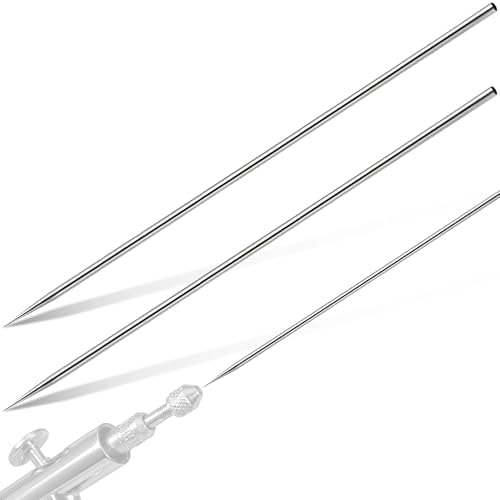
Less often than most people think. Steel needles do wear at the very tip over years of heavy use, but the overwhelming reason painters buy a new one is mechanical damage: a bend from pulling the needle back too far, a hook from pushing it into a nozzle that still had dried paint in it, or a drop onto a hard floor.
Roll the needle across a sheet of glass to check. A straight needle rolls silently and evenly. A bent one wobbles, and you will see daylight under the tip as it turns. A tip that has been hooked catches the light differently from the rest of the taper. Our guide to a bent airbrush needle covers what you can straighten and what you cannot.
What a Failing Nozzle Looks Like
Usually like nothing at all. The most common nozzle failure in hobby brushes is a hairline split running back from the tip, invisible at arm’s length and visible under a loupe or a phone camera at maximum zoom. The symptom is air escaping where it should not, which reads at the model as bubbles in the cup or a sudden fine spatter.
The second failure is a deformed opening from over tightening. Threaded nozzles are small brass or steel parts and the torque a person can apply with a wrench is far more than they need. Snug is the whole instruction. If you have ever cracked one, it was almost certainly during reassembly rather than during spraying.
Threaded and Self Centering Nozzles Are Not the Same Job
Two designs dominate. Threaded nozzles screw into the head and need a small wrench, which is why Iwata style brushes ship with one. Self centering nozzles drop into a recess and are held by the head cap, which is the approach Harder & Steenbeck uses on the Ultra and Evolution, and it is the reason there is no wrench in those boxes.
The practical difference is the failure mode. Threaded nozzles crack from over tightening and strip from cross threading. Self centering nozzles are easier to fit but easier to lose, because they are a loose part the moment the cap comes off. Work over a tray, not over a carpet.
What Fails, How You Notice, What You Do
Most of the diagnosis is in matching a symptom to the part. This is the short version, and it is worth reading before you start changing paint ratios, because thinning cannot fix a mechanical fault.
| Part and fault | How it shows up | How to confirm it | Fix |
|---|---|---|---|
| Bent needle tip | Spray drifts to one side, paint creeps onto the tip | Roll it on glass, look at the tip in light | Polish a slight hook, replace a real bend |
| Cracked nozzle | Bubbles in the cup, sudden spatter | Phone camera at full zoom, or a loupe | Replace, it cannot be repaired |
| Dried paint in the nozzle | Weak flow, needs more trigger for the same paint | Soak and check the opening against a light | Clean, do not ream it dry |
| Worn needle bearing or seal | Paint leaks back into the body, sticky trigger | Strip and look for color behind the cup | Replace the seal from the parts list |
Ordering the Right Part
Order by brush model first and size second. Manufacturers publish exploded parts diagrams with numbered items, and the item number is the only reliable way to buy. Listings that say only a size are guessing on your behalf, and a needle that is the correct diameter but the wrong length or taper will not seat.
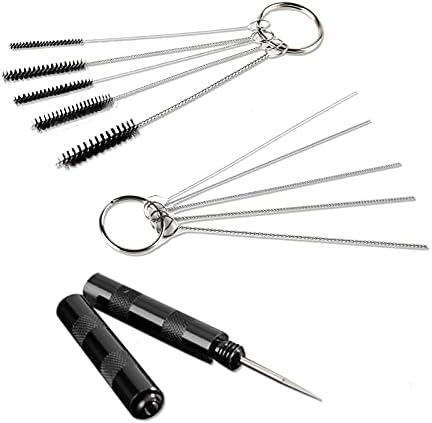
Availability varies by brand as well. Master Airbrush and Gaahleri sell their own parts as sets, which is convenient because you get the small seals in the same order. Premium brands are widely stocked through hobby dealers as well as through the big marketplaces, so check both if a specific item number is out of stock. Our overview of airbrush replacement parts covers the rest of the consumables.

Keeping a Spare Set on the Shelf
The argument for a spare is not the cost of the part, it is the cost of the interruption. You break a nozzle on a Sunday evening halfway through basecoating a squad, and without a spare the project stops for a week. With one in the drawer it stops for two minutes.
A sensible shelf kit is one needle, one nozzle and a small pack of the seals your brush uses, all matched to your model. If you own a modular brush, a combined kit that includes the head assembly is worth more than the individual parts, because head damage and nozzle damage tend to arrive together.

Frequently Asked Questions
How do I know if my nozzle is cracked? Take it off, clean it, and photograph it with a phone camera at maximum zoom against a plain background. A split shows as a dark line running back from the tip. If the brush bubbles in the cup with a clean needle and a properly seated nozzle, a crack is the most likely explanation. Our page on airbrush sputtering covers the other causes.
Can I use a different brand’s needle in my airbrush? No, and it is not worth the experiment. Tapers, lengths and seating shoulders differ between models even within one brand. A near fit leaks paint past the seal, which then dries inside the body and creates a second problem on top of the first.
Do I need to change the needle when I change nozzle size? Yes. The two are a matched pair, and fitting a smaller needle into a larger nozzle simply leaves a gap that never closes. Buy the size change as a set, which is how most manufacturers list them. Our guide to airbrush nozzle size explains which size is worth owning.
How tight should a threaded nozzle be? Finger tight, then the smallest nudge with the wrench to seat it. If you are applying real force you are past the point where you are helping. Most cracked nozzles in this hobby were cracked during assembly by someone being careful.
Why does paint dry on my needle tip so fast? That is tip dry, and it is usually about paint consistency, pressure and the paint itself rather than a fault in the parts. It becomes a parts question only when the tip is hooked and holding paint mechanically. Our guide to airbrush tip dry works through it.
The Bottom Line
Needles and nozzles are consumables that fail from handling rather than from hours, and both failures disguise themselves as paint problems. Learn to roll a needle on glass and to photograph a nozzle at full zoom, order spares by model and item number rather than by size, and keep one set in the drawer so a broken part costs you a minute instead of a week. Read next: how to clean an airbrush nozzle without damaging it, and what to do after every session.