Last updated: August 23, 2026
Iwata is the brand people trust for airbrushes, so it is natural to assume the compressors carry the same advantage. They are good machines. They are also, in the ways that matter for a hobby bench, doing the same job as compressors that cost far less, and the step up buys refinement rather than capability.
That is worth saying plainly before anything else, because the compressor is the one part of the setup where paying more changes the least about your painting. What it does change is noise, longevity, fittings and the experience of using the thing several evenings a week for a decade.
This article contains affiliate links. If you buy through them, we may earn a commission at no extra cost to you. Learn more.
Quick Answer
Which Iwata compressor makes sense for model painting?
- Smart Jet Pro: the standard choice. Auto shut-off, quiet, tankless, plenty of air for one brush.
- Ninja Jet: the compact one. Smallest and simplest, for a bench with no room.
- Power Jet Pro: the tank model with two regulators, for two workstations or long smooth work.
- None of them will make your paint atomize better than a good budget compressor does.
Bottom line: buy Iwata air for the quiet, the build and the parts availability, not for spray quality.
What the Studio Range Covers
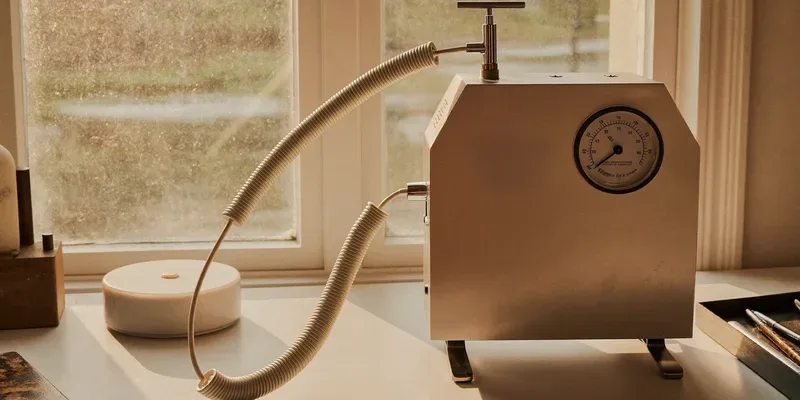
Iwata sells its compressors as the Studio Series, a small family of oil free piston units aimed at exactly this use. The lineup runs from a compact tankless unit through the mainstream tankless models to a tank version with two outlets, and the company brands its auto shut-off as Smart Technology.
All of them are designed around a single airbrush at hobby pressure, which is a light load. The differences between the models are size, noise, whether there is a tank, and how many brushes can run off one unit, rather than any difference in the air that reaches your nozzle.
Smart Jet Pro: the Default Answer
This is the model most model painters end up with. Iwata lists the Smart Jet Pro at 1/8 horsepower with a maximum of 40 PSI, air flow of 0.64 CFM at 20 PSI, a noise level of 50 db and a weight of fourteen pounds, with auto shut-off so the motor stops when you stop.
Read those numbers against what miniature painting needs and the picture is clear: far more air than one gravity feed brush uses, at pressures well above where you will work. The reason to buy it is that it does that quietly, stops itself between passes, and is built to keep doing so.

Ninja Jet: Small, Simple, Fewer Features
The Ninja Jet is the compact end of the range: a small maintenance free unit with adjustable pressure, aimed at a bench with no space or a setup that has to be put away. It is the Iwata answer to the question of how little compressor you can sensibly own.
You give up features rather than air. Less mass means it works harder for the same output, and the smallest units in any brand’s range are the ones to be careful about running for long unbroken stretches. For an hour of evening painting with pauses, that is not a real constraint.

Power Jet Pro: the Tank and Two Outlets
Iwata lists the Power Jet Pro with a two liter air storage tank, a 1/6 horsepower motor and two separate regulators, so two workstations can run from one compressor. That is the model for a shared bench, for someone who keeps a primer brush and a detail brush both connected, or for anyone who wants completely flat air.
The tank does what tanks always do: removes the pulse and lets the motor rest, which also means the unit is silent for most of a session. If that is what you are after, our guide to the airbrush compressor with tank covers whether it is worth the step for how you paint.

The Iwata Models Side by Side
The table sets the three out on what actually differs. Figures are the ones Iwata publishes for these models; the rest is how they behave on a bench.
| Model | Air supply | Suits | Trade off |
|---|---|---|---|
| Ninja Jet | Compact, tankless | Tiny benches, put away each time | Fewest features, works hardest |
| Smart Jet Pro | Tankless, auto shut-off, 0.64 CFM at 20 PSI | Most model painters | Faint pulse from tankless running |
| Power Jet Pro | Two liter tank, two regulators | Two brushes, long smooth work | Biggest and heaviest of the three |
| Budget tank unit | Tank, fan, regulator, trap | Same job for less outlay | Parts and service are not comparable |
What the Money Actually Buys
Quiet running, fittings that seal and keep sealing, a pressure switch that keeps its calibration, and a dealer network that can sell you a spare part in five years. Those are real benefits and they accumulate over a long ownership rather than showing up on the first model you paint.
What it does not buy is finer atomization. The airbrush and your thinning decide that, not the pump. If your budget is finite and you are choosing between a premium compressor with a basic brush or a basic compressor with a good brush, put the money in the brush every time.
How It Compares With Sparmax and the Budget Tier
Sparmax builds compressors of very similar design and specification for this market, and the two ranges get compared constantly. Sparmax publishes 0.49 CFM and auto on and off at 40 and 60 PSI for the TC-501N, which is the same class of machine doing the same job with the same accessories in the box.
Below that sits the Amazon tier: Master Airbrush, TIMBERTECH and similar, where you get a tank and a cooling fan for less and give up parts availability and refinement. Our guide to budget airbrush compressors covers where those units cut corners and whether it matters.

Frequently Asked Questions
Do I need an Iwata compressor to use an Iwata airbrush? No. Any compressor with a regulator and a moisture trap will run an Eclipse or an HP perfectly well, and the fitting is standard 1/8 inch BSP. Brand matching makes no difference to the spray. See our guide to the Iwata airbrush range for the brush side.
Is the Smart Jet Pro quiet enough for an apartment? Iwata publishes a noise level of 50 db for it, and the auto shut-off means it is silent for most of a session. Most of what people hear from any compressor is vibration through the table, so put it on the floor on something soft before you judge it.
Does the Smart Jet Pro have a tank? No, it is tankless with auto shut-off. Pressure is steady enough for almost all model work, with the faint pulse inherent to tankless designs. The tank version in the range is the Power Jet Pro.
Can I run two airbrushes from one Iwata compressor? On the Power Jet Pro, yes, since Iwata fits two regulators for exactly that. On a tankless unit you can connect two brushes through a manifold, but spraying with both at once will out breathe a small compressor.
Is a premium compressor worth it for a beginner? Rarely, as a first purchase. A beginner benefits far more from a good brush, a regulator and enough paint to practice with. The compressor is the part you can upgrade later without relearning anything, which makes it the sensible thing to buy second.
The Bottom Line
The Smart Jet Pro is the model that fits most model benches, the Ninja Jet is for benches with no room, and the Power Jet Pro is for two brushes or completely flat air. All three are well made and none of them will improve your finish over a competent budget unit with a good regulator and trap. Buy Iwata air if you want quiet and a long service life; put the money in the brush if you are choosing between the two. Read next: how to pick an airbrush compressor and the Iwata airbrush lines explained.