Last updated: August 23, 2026
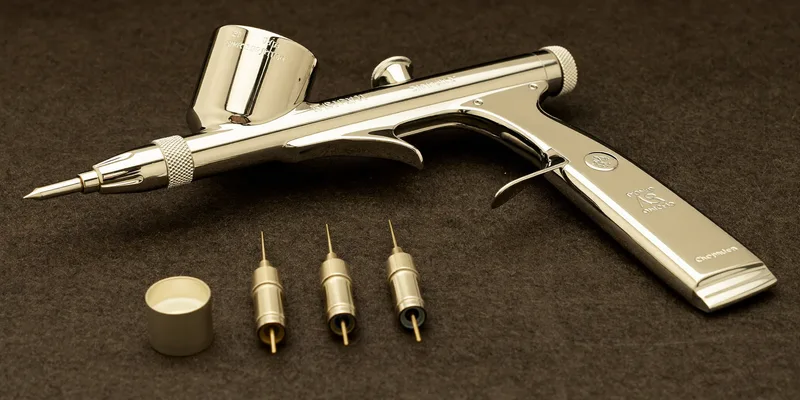
Most first airbrush purchases are a guess about nozzle size. You read that 0.2mm is for detail and 0.5mm is for coverage, you pick something in the middle, and six months later you find out you would have been happier with the other one. The G233 pro set solves that by putting all three in the box.
It is also the quiet alternative to the heavily advertised beginner kits that dominate the top of these search results. Being advertised is not the same as being recommended, and this brush is the version of that purchase with a longer track record behind it.
This article contains affiliate links. If you buy through them, we may earn a commission at no extra cost to you. Learn more.
Quick Answer
Should you buy the Master Airbrush G233 pro set?
- You do not yet know which nozzle size suits your work: this is the cheapest way to find out.
- You want one brush for primer and one setup for detail: swap the head instead of buying twice.
- You want premium atomization at low pressure: this tier does not reach it.
- You hate keeping track of small parts: three nozzle sets means three sets to lose.
Bottom line: an honest, well documented mid tier brush that teaches you what you actually need.
What Is in the Box
Master lists the G233 pro set as a dual action gravity feed airbrush with three complete nozzle sets, at 0.2mm, 0.3mm and 0.5mm, each comprising a needle, a fluid tip and an air cap. It has a one third ounce cup, a cutaway handle, and solvent resistant needle packing, and the pro set adds a braided hose with a quick disconnect.
Complete sets are the important detail. Some brands sell you a spare needle and expect the tip to be shared, which does not work, because a needle and a tip wear as a pair and must match.

The Cutaway Handle
The handle is open at the back so you can reach the needle chuck without removing it. That lets you pull the needle back a fraction to clear a blockage or push it forward gently to seat it, which turns a session ending clog into a ten second fix. It also means the back of the brush is open, so do not stand it in a puddle of cleaner.
Three Nozzle Sizes and What Each One Teaches
The 0.3mm set is the everyday answer for miniatures and models. The 0.5mm is for primer, varnish and terrain, the jobs that clog fine setups. The 0.2mm is for freehand and glazing, and it is the one that punishes thick paint hardest.
Spend an evening with each. You will learn more about thinning ratios and pressure from swapping heads than from any amount of reading, and you will know which size to buy when you eventually move up a tier.
Swapping Is Not Instant
A head change means cleaning the brush first, then removing the air cap, tip and needle and fitting the matching set. Five minutes, not five seconds. Most owners settle on one size and keep the others for specific jobs rather than swapping mid session.

How It Sprays
Competently, at the tier it belongs to. With paint thinned to a milk consistency and pressure set in the mid teens, the 0.3mm head produces even coats and lines fine enough for camouflage edges. The listing suggests a working range of roughly 15 to 30 PSI, which matches what model painters use in practice.
Where it falls short of premium brushes is atomization at the very bottom of the pressure range, which shows as a slightly grainier finish on large flat areas. On a table top army that difference is invisible; on a photographed display piece it is not.
The G233 Against the Alternatives
The four brushes people compare at this level, with the manufacturer’s published figures.
| Airbrush | Nozzle sets included | Notable feature | Pick it when |
|---|---|---|---|
| Master G233 pro set | 0.2, 0.3 and 0.5mm | Cutaway handle, solvent resistant packing | You want to try all three sizes |
| Master G22 | 0.3mm only | Simplest everyday option | You already know 0.3mm suits you |
| Gaahleri GHAD-39 | 0.35 and 0.5mm | Spare seals and lube in the box | You want spares supplied |
| Iwata Neo CN | 0.35mm, two cups | Entry line from a premium maker | You value the brand’s design pedigree |
The wider picture is in our brands comparison.
The Advertised Alternative
Several beginner kits buy the top advertising slot on airbrush searches, and one in particular appears first on multiple queries while its owner feedback sits well below what that visibility implies. Ad placement is bought, not earned, and a kit that appears first is not a kit that has been judged best by anyone.
The G233 is the boring version of that purchase: less prominent, longer on the market, and documented by a large body of owner feedback rather than by placement. We look at the advertised competitor in detail on our page about that brand.
What You Still Need
Air, first. The brush alone assumes you have a regulated compressor with a moisture trap, and if you do not, the kit versions bundle one. Then a cleaner suited to your paint, a thinner, and somewhere for the overspray to go.
Our starter kit guide lists the full set of purchases, and the Cool Runner II review covers the compressor most often bundled with this brush.

Frequently Asked Questions
Is the G233 good for miniature painting? Yes, with the 0.3mm head fitted. It primes, basecoats, shades and pulls a line fine enough for most freehand. The limitation is atomization at very low pressure, which affects how smooth large flat areas look rather than what the brush can do.
Do I need all three nozzle sizes? No, but owning them is how you find out which one you want. Most painters settle on the middle size and keep the largest for primer and varnish. The smallest is the one that sits unused unless you do fine freehand.
Can I buy replacement needles and tips? Yes, they are listed as matched sets by the brand. Buy the needle and tip together rather than separately, since a worn pair does not seal correctly when mixed with new parts.
What pressure should I use? The listing suggests roughly 15 to 30 PSI as a general range. For miniatures, the mid teens suits detail and shading and the upper end suits primer. Our PSI guide gives working figures by task.
Why does the 0.2mm head clog so quickly? Because a fine tip demands thinner paint and a clean start. Thin further, raise the pressure a little, and clear the tip before it dries. Our guide to tip dry works through the free fixes in order.
Is it better than the more heavily advertised beginner kits? It has a much longer track record and a documented parts list, which matters more than which listing appears first. Whether it is better than any specific competitor depends on that competitor, and we cover the most advertised one separately.
The Bottom Line
The G233 pro set is the sensible way to answer the nozzle size question, because it lets you spray with all three and decide from experience rather than from a chart. It is a mid tier brush with a mid tier ceiling on atomization, and it says so honestly through a long history of owner feedback rather than through advertising placement. Fit the 0.3mm head, thin your paint properly, and it will do everything a miniature painter needs while you work out whether you want to spend more. Read next: the Master Airbrush range and the nozzle size guide.