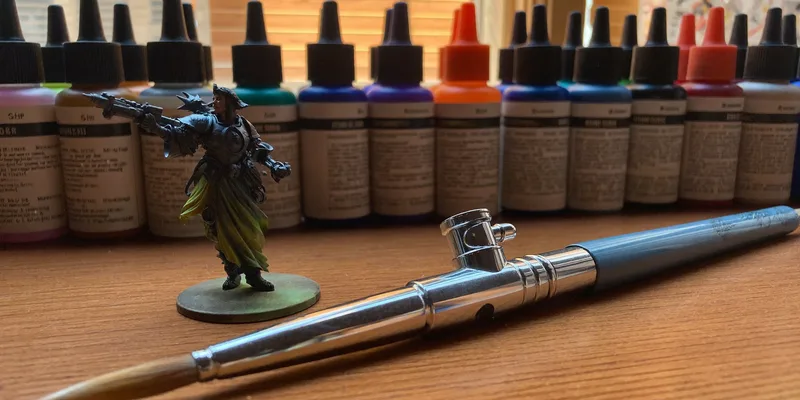
Last updated: August 23, 2026
You bought the airbrush to get through the pile of gray plastic faster, and now you are standing in front of a wall of paint ranges trying to work out which of them will actually go through a 0.3 mm nozzle without a fight. The labels are not much help, because almost everything says something about airbrushing somewhere on the bottle.
The useful distinction is narrow. A handful of ranges are formulated thin enough to spray with little or no adjustment, a much larger group sprays perfectly well once you thin it, and a few are simply the wrong tool. Here is where the lines fall for miniature painting specifically.
This article contains affiliate links. If you buy through them, we may earn a commission at no extra cost to you. Learn more.
Quick Answer
Which paint should go in an airbrush for miniatures?
- Widest range and the safest default: Vallejo Model Air, formulated for spraying.
- Matching an existing Warhammer scheme: Citadel Air, pre thinned and color matched to the main range.
- Starting from nothing on a budget: a large marketplace set gets you painting, with more thinning.
- Already own brush paints: keep them, thin them, and buy a thinner rather than a whole second range.
Bottom line: ready to spray ranges save a step, they do not remove the need to judge consistency.
What Ready to Spray Really Means
It means the maker has already thinned the paint to roughly the consistency an airbrush wants, and milled the pigment fine enough to pass a small nozzle. It does not mean every color in the range behaves identically. Dense pigments and metallics run thicker in every line ever made, and those are the bottles you will still be adjusting.
Treat the claim as a starting point rather than a guarantee. A range sold for airbrushes gets you to a usable spray with one or two drops of thinner where a general range might need five, and that difference is worth paying for while you are learning.
If You Want One Range That Covers Everything
Vallejo Model Air is the default recommendation and has been for years. It is a wide range in dropper bottles, formulated for spraying, and the dropper matters more than it sounds: it lets you count drops of paint against drops of thinner, which is how you learn ratios instead of guessing.
The range was built around military and aviation subjects, so the color coverage skews that way, but it is deep enough that fantasy painters use it happily. Our Vallejo guide explains how Model Air differs from Model Color and Game Air, which is the question everyone hits in their first week.

If You Are Matching a Warhammer Scheme
Citadel Air exists to solve one specific problem: you already paint a scheme in Citadel colors and you want the airbrushed basecoat to match what you brush on afterward. Games Workshop states that the Air range is color matched to the main Citadel range and supplied ready thinned for airbrush use in 24 ml pots.
The pots are the weak point rather than the paint. Pots are harder to measure from than droppers and they dry out if left open, which is why plenty of painters decant. Our Citadel Air article covers whether the color matching is worth the format.

If You Are Starting From an Empty Shelf
Large marketplace sets sell in serious volume for an obvious reason: a box of two or three dozen colors costs less than a handful of hobby range bottles and gets you spraying this weekend. The pigment quality is not the same, coverage on some colors is thin, and you will thin them more carefully. For learning trigger control and blending, none of that matters much.
The sensible use of a set like this is as practice paint. Spray terrain, spray test models, spray the underside of things, and buy specific hobby range colors for the models you care about once you know what you are doing.

If You Already Own a Pile of Brush Paint
Keep it. Almost all modern miniature acrylics can be sprayed once they are thinned properly, and buying a thinner is far cheaper than buying a parallel range. Game Air and similar lines exist mainly as a convenience, not because brush paint is incapable of going through a nozzle.
What you will notice is the extra step and the occasional stubborn color. Some heavily pigmented brush paints need a flow improver as well as a thinner to stop them drying on the tip. Our guide to thinning acrylic paint covers the ratios and what to do about the awkward bottles.
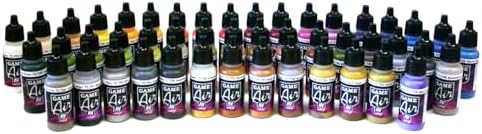
The Options Compared
Four ways to fill the cup, ranked by how much work each one asks of you before the paint reaches the model.
| Range | Format | Preparation | Best for |
|---|---|---|---|
| Vallejo Model Air | Dropper bottles | Little to none, adjust dense colors | A single range for everything |
| Citadel Air | 24 ml pots | Ready thinned, decanting helps | Matching an existing Citadel scheme |
| Large marketplace set | Bottles, many colors | Thin carefully, expect variation | Practice, terrain, starting cheap |
| Brush paint you already own | Pots or droppers | Thinner and sometimes flow improver | Not buying a second range |
The Two Bottles That Are Not Paint
Whichever range you choose, two supporting products do more for your results than a wider color selection would. A thinner made for your paint family, so you are not diluting the binder with tap water, and a flow improver for the colors that keep drying on the tip.
Add a primer to that list and you have the whole shopping list. Our guide to airbrush primer covers the ranges that spray straight from the bottle, which is the step most beginners skip and then wonder why the paint rubs off.
Storage Matters More Than People Expect
Paint that has stood untouched for months separates, and a bottle that has not been shaken back together sprays badly and gets blamed on the airbrush. Store bottles upright, shake properly before every session rather than giving them a lazy swirl, and drop a mixing ball into any bottle that does not already have one.
Frequently Asked Questions
Can I airbrush Citadel Base and Layer paints? Yes, thinned. They are thicker than the Air range and they come in pots, so measure by decanting a little into a mixing well rather than pouring straight into the cup. Expect to add more thinner than you would with a dedicated airbrush range.
Is Vallejo Model Air really ready to spray? For most colors, close enough to load and go. Metallics and some dense opaques still want a drop or two of thinner. Judge each bottle by how it runs off the stirrer rather than by the label.
How many colors do I actually need to start? Fewer than you think. A primer, a couple of basecoat colors for your army or model, and a white or bone for zenithal work will carry you through the first several projects. Buy depth in the colors you use, not breadth.
Do cheap paint sets ruin your airbrush? No, but they block it more often if you spray them unthinned. Coarser pigment and heavier binder are the reason. Thin them properly, run a backflush between colors, and a budget set is perfectly usable.
What about metallic paints through an airbrush? They spray, with two caveats: the flakes need a slightly larger nozzle than fine detail work and they settle fast, so shake the bottle and stir the cup. Clean immediately afterward, since metallic pigment left to dry in a nozzle is stubborn.
The Bottom Line
Vallejo Model Air is the range to default to if you want one shelf that covers everything, Citadel Air is the answer when the airbrushed coat has to match a scheme you already brush, and a large marketplace set is a fine way to learn on terrain and test models. Whatever you pick, buy the thinner that belongs to it and judge every bottle by how it runs rather than by what the label promises. Read next: the airbrush paint types explained and how to airbrush miniatures step by step.