Last updated: August 23, 2026
Only a fraction of what leaves an airbrush lands on the model. The rest carries past it, slows down, and settles wherever the air in the room takes it. You can see the evidence within a few sessions: a faint film on the lamp, a tint on the windowsill, the shelf of finished models slowly acquiring a matte haze that was not there when you put them up.
This page is about where that goes and what to do about it in a normal house, without a garage and without a workshop. It is deliberately not a shopping list. The answers here are about air, and the products that help are covered elsewhere on the site.
This article contains affiliate links. If you buy through them, we may earn a commission at no extra cost to you. Learn more.
Quick Answer
How much ventilation does airbrushing actually need?
- Capture at the source beats moving air around the room. A booth vented outside does most of the work.
- Water based acrylic and solvent based paint are different problems. The safety data sheet for your paint says which one you have.
- An open window alone is weak unless something is pushing or pulling air through it.
- Read the manufacturer’s sheet for the product in your cup. That is the instruction, not a forum consensus.
Bottom line: capture the mist where it is made, move it outdoors, and let the paint’s own safety data sheet set the rest.
Where the Overspray Actually Goes
Into the room, in two forms. The heavier droplets fall out of the air within a short distance and land on the desk, the towel and everything within arm’s reach. The finer mist stays airborne much longer, drifts on whatever air currents the room has, and settles gradually on surfaces well away from where you were painting.
That second fraction is why a painting corner slowly changes the whole room. It is also why the useful question is not how big the room is but whether anything is removing the air rather than stirring it. A fan pointed at you moves the mist somewhere else in the room. It does not take it out.
Capture Beats Dilution
Catching mist a few inches from the nozzle, while it is still concentrated and moving in one direction, is far easier than dealing with it once it has spread through the room. This is the entire reason a booth works, and the reason a booth vented outside is worth more than a much larger amount of general room airflow.
What the Safety Data Sheet Actually Says
It says different things depending on what is in the bottle, which is exactly why it is the document to read. Two examples that cover most of this hobby show how far apart the two ends are, and both sheets are published by the manufacturers and available free.
Acrylicos Vallejo’s safety data sheet for Model Air, version 2 revised in March 2019, states that the product is not classified as hazardous under the CLP regulation and that there are no occupational exposure limits for the substances it contains. Even so, section 8 of that sheet lists a particle filter mask under respiratory protection, with the note to use it in accordance with the manufacturer’s limitations and the relevant workplace standard. A water based paint is still an aerosol once it leaves the nozzle.
The Solvent End
The Tamiya safety data sheet for its lacquer paint thinner, version 1.0 issued in April 2019, is a different document. It classifies the product as a highly flammable liquid and vapor, carries the precautionary statements to avoid breathing mist and vapors, to use only outdoors or in a well ventilated area, and to use explosion proof electrical equipment, ventilation and lighting. Its section 7 instructs users to ensure good ventilation and exhaust at the workplace, and its section 8 lists occupational exposure limits for the solvents in it, which the Vallejo sheet does not have.
Why a Window Alone Is Weak
An open window is a hole, not a ventilation system. Air moves through it only when something drives it: wind outside, a temperature difference, or a fan. On a still day in a room with the door shut, a window on its own produces very little exchange, and the mist you generate stays with you.
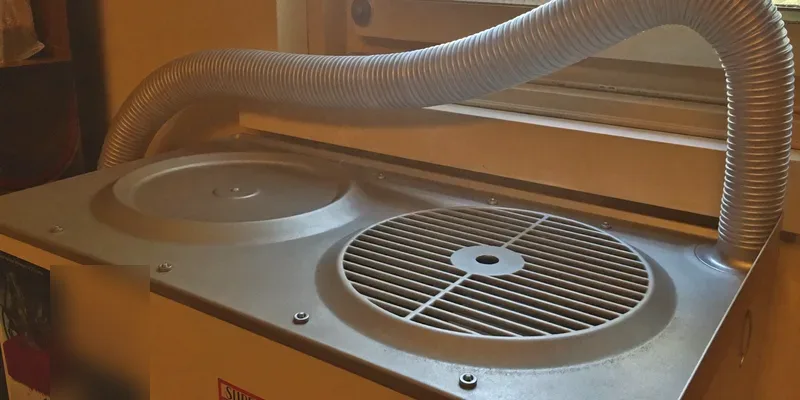
What turns a window into ventilation is direction. Put an extraction route at the window so air leaves there, and let replacement air come in from elsewhere in the home, typically under the door. Now the room has a flow, it goes past you toward the window rather than around the room, and the mist travels with it.
Setting Up in a Rented Room
You are working with what you can undo. A window panel cut from foam board or plywood, with a duct opening in it, sits in a sash window and comes out again with nothing drilled and nothing painted. That single item converts almost any rented room into a workable painting space.
Position matters as much as hardware. Sit so that the route from your brush to the extraction point does not pass your face, which usually means the booth in front of you and the duct going away from you rather than across. Our spray booth guide covers the capture side and our build guide covers making a panel and box yourself.
Other People and Animals in the Room
The simple version is that the painting session should not share air with anyone who is not painting. Close the door, work when the room is yours, and let the room clear with the extraction still running for a while after you finish rather than switching everything off and leaving immediately.
For pets, the practical rule is the same and easier to enforce: they are not in the room, and the door stays shut. Small animals kept in the same room as a hobby bench should be somewhere else during and after a session. If you are unsure about a specific product and a specific animal, ask a veterinarian rather than a forum, and bring the safety data sheet to the question.
What Each Measure Does
The confusion in most discussions of this topic comes from treating four different things as if they were interchangeable. They are complementary, they handle different parts of the problem, and none of them replaces reading the sheet for what you spray.
| Measure | Handles | Does not handle | Where it fits |
|---|---|---|---|
| Booth vented outside | Mist at the source, air removal | Nothing already spread through the room | The foundation of an indoor setup |
| Booth recirculating | Overspray on the room and shelves | Removing air from the space | Better than nothing on a shared table |
| Open window with a flow | Diluting and exchanging room air | Capture near the nozzle | Alongside a booth, not instead |
| Respirator | What reaches you personally | The rest of the household or the room | Last line, matched to the sheet |
Booth, Mask or Both
Both, in that order of priority. Ventilation and capture deal with the room and everyone in it, which a mask on your face cannot do. A respirator deals only with the air you personally breathe, and it does that only when it is the right device, correctly fitted and correctly maintained.
NIOSH is the body that certifies respirators in the United States, and its approvals cover respirators specifically, not booths, paints or compressors. If you are going to add one, choose it against the paint’s safety data sheet and check the NIOSH approval on the device itself. Our page on the airbrush respirator works through how to read those labels.
Frequently Asked Questions
Do I need ventilation for water based acrylics? Treat the aerosol as the reason rather than the chemistry. Vallejo’s safety data sheet for Model Air says the product is not classified as hazardous and lists no occupational exposure limits, yet section 8 still shows a particle filter mask under respiratory protection. Capturing the mist and venting it out is the sensible default.
Is a fan blowing across the desk enough? No. A fan blowing at you moves mist to another part of the room and puts it into the air you are in. If you use a fan, use it to pull air out through an opening rather than to stir the room, so there is a direction to the flow.
What does the safety data sheet actually tell me? The handling section tells you what ventilation the manufacturer expects, the exposure controls section tells you what protection they list, and the hazards section tells you which of the two categories your paint is in. Every major hobby paint brand publishes theirs online for free.
Can I airbrush in a room with no window? That is the hardest case and it needs a route to the outside rather than a bigger filter, since a recirculating setup returns the air to the same room. If no route exists, spray water based paints only, keep sessions short, and follow the handling instructions on the sheet for the product.
Does an air purifier count as ventilation? It is filtration, not exchange. A purifier can reduce settled dust and airborne particles in the room over time, which is useful, but it does not remove air from the space and it is not what a sheet means by well ventilated. Use it in addition, never instead.
The Bottom Line
Catch the mist where it is made, give the room a direction so the air actually leaves, and let the manufacturer’s safety data sheet for whatever is in your cup decide how careful the setup needs to be. Vallejo’s sheet and Tamiya’s sheet describe two genuinely different situations, and knowing which one you are in is more useful than any general rule about window openings. Read next: choosing a spray booth and what NIOSH approval on a respirator means.