Last updated: August 23, 2026
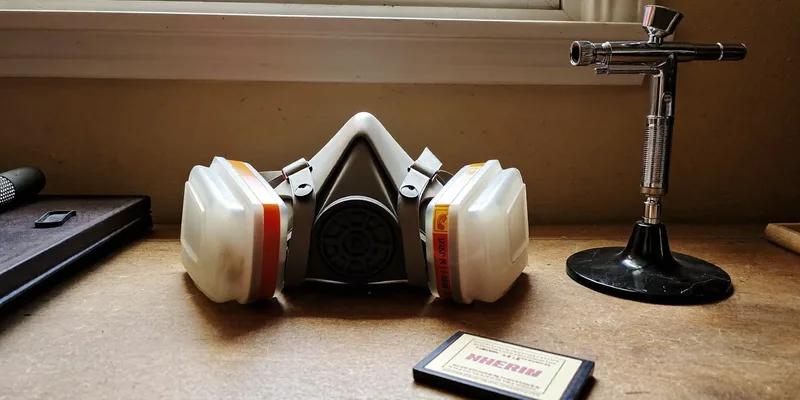
The paper mask in the drawer from the last time you sanded a wall is not a respirator, and the difference is not a technicality. One is a barrier against dust that fits where it fits. The other is a certified device with a defined seal and a filter chosen to match what is in the air, and the certification only means anything if you have picked the right combination.
This is the part of the hobby where guessing is worst, because everything looks approximately similar in a listing photo. The good news is that the two documents you need are both free and both published by people with no product to sell you: the safety data sheet for your paint, and the approval on the device itself.
This article contains affiliate links. If you buy through them, we may earn a commission at no extra cost to you. Learn more.
Quick Answer
What respirator do you need for airbrushing?
- Start from the paint. Its safety data sheet lists what the manufacturer expects under respiratory protection.
- A dust mask is not a respirator. NIOSH certifies respirators and the approval is printed on the device.
- A tight fitting device only works if it seals, and NIOSH guidance says facial hair must not cross the sealing surface.
- The respirator is the last line. Capture and ventilation come first because they protect the room too.
Bottom line: match the device to the sheet, check the NIOSH approval on the box, and make sure it actually seals on your face.
What NIOSH Approval Means
In the United States, NIOSH is the body that tests and certifies respirators, and approved devices carry an approval number and are listed on its Certified Equipment List. That certification covers the respirator and the filters or cartridges approved with it as a combination, which is why swapping in a part from another maker voids the approval.
What NIOSH does not certify is everything else in your setup. There is no such thing as an approved spray booth, an approved paint or an approved compressor, and any listing that implies otherwise is using the word decoratively. The approval belongs to the breathing device alone.
Reading the Label
An approved device carries the NIOSH name, the approval number and the class of the filter element on the packaging and usually on the part itself. If you cannot find that on a listing, treat the absence as the answer. The Certified Equipment List is public and searchable if you want to confirm a specific number.
Particles and Vapors Are Two Different Jobs
Airbrushing produces an aerosol, which is liquid droplets suspended in air. Solvent based products additionally produce vapor as the carrier evaporates. NIOSH certifies particulate filters and chemical cartridges as separate categories, and a device set up for one does not address the other.
That is the reason a dust mask is inadequate for solvent work no matter how well it fits: a NIOSH certified N95 is a particulate filter, and gases and vapors are covered by cartridges NIOSH approves separately. Combination arrangements exist precisely because painting often involves both at once. Which one you need is a question for the safety data sheet of the product you are spraying, not for a rule of thumb.

Letting the Sheet Choose the Cartridge
Every serious hobby paint manufacturer publishes a safety data sheet, and section 8 of that sheet is where they state the respiratory protection they expect. Read that section for the specific product, because it varies enormously across a single brand’s range.
Acrylicos Vallejo’s sheet for Model Air, version 2 revised in March 2019, states that the product is not classified as hazardous and that its substances have no occupational exposure limits, yet still lists a particle filter mask under respiratory protection, to be replaced when breathing resistance increases and used according to the manufacturer’s limitations. Tamiya’s sheet for its lacquer paint thinner, issued in April 2019, is at the other end: highly flammable liquid and vapor, with precautionary statements to avoid breathing mist and vapors and to use only outdoors or in a well ventilated area. Those two sheets do not describe the same purchase.
Fit Is the Whole Device
A tight fitting respirator works by making the easiest path for air the one through the filter. If air can get around the edge, it will, and the filter becomes decoration. That is why fit is not a comfort question but the mechanism itself.
NIOSH publishes guidance on facial hairstyles and tight fitting respirators, and the rule it sets out is simple: hair must not cross the sealing surface. Beards and even a few days of stubble along that line prevent a seal. If you have a beard you want to keep, that steers you toward capture and ventilation rather than toward buying a device that will not seal on you.
Getting the Size Right
Half facepieces come in sizes and the difference is real, particularly across the bridge of the nose and under the chin. A device that leaves a gap at the chin on a small face will never seal regardless of how tight the straps are, and overtightening straps to compensate distorts the facepiece and makes it worse.

Maintenance and Replacement
Cartridges and filters are consumables with a working life that depends on what you spray and how much of it, and the manufacturer of the device sets the change schedule. Follow theirs rather than a number you read somewhere, and store the device sealed in a bag between sessions so the cartridges are not quietly working through their capacity on the shelf.
| Item | What it handles | Who tells you when to change it | Storage |
|---|---|---|---|
| Particulate filter | Aerosol droplets and dust | Device maker, plus rising breathing resistance | Sealed bag, away from the bench |
| Chemical cartridge | Vapors, per the SDS for the product | Device maker’s change schedule | Sealed bag, dated when opened |
| Facepiece | The seal itself | When straps or seal perish | Clean per the maker’s instructions |
| Disposable dust mask | Dust, not vapor | Single use | Not a substitute for the above |

Where It Sits in the Setup
Last. A respirator protects one person, the one wearing it, and only while it is on and sealed. Extraction and capture protect the room, the people in it and the surfaces in it, and they keep working when you take a break or answer the door with the mask off.
The setups that work best treat the mask as the final layer over a booth that vents outside, rather than as the thing that makes a poorly ventilated room acceptable. Our page on airbrush ventilation covers the layer underneath, and our spray booth guide covers capture.
Frequently Asked Questions
Do I need a mask for water based acrylics? Read the sheet for your paint and decide from that. Vallejo’s Model Air sheet states the product is not classified as hazardous and lists no occupational exposure limits, and still shows a particle filter mask under respiratory protection in section 8. Spraying turns any paint into an aerosol, which is the reason.
Is an N95 enough for airbrushing? A NIOSH certified N95 is a particulate filter, so it addresses droplets and not vapors, and NIOSH approves cartridges for gases and vapors separately. Whether that is enough depends entirely on what the safety data sheet for your product says. For solvent based paints it is not the device the sheet points to.
Can I wear a respirator with a beard? Not a tight fitting one, if the hair crosses the sealing surface. NIOSH’s guidance on facial hairstyles is explicit that hair must not cross that line. The practical answer for bearded painters is to put the effort into extraction and capture instead.
How often do cartridges need changing? Follow the change schedule from the maker of the respirator, since it depends on the device, the cartridge and what you spray. Storing the device sealed between sessions matters too, because cartridges do not pause when you put them down on the bench.
Does a booth mean I can skip the mask? A booth vented outside removes most of the mist at the source, which is a large part of the problem solved. Whether you also wear a device is a judgment based on the sheet for your paint and the room you are in. Our page on building a booth covers getting the capture right first.
The Bottom Line
Let the safety data sheet for the paint choose the device, check that the device carries a NIOSH approval, and confirm it seals on your actual face before you rely on it. A dust mask is for dust, particulate filters and chemical cartridges are separate certifications, and no amount of strap tension fixes hair crossing the seal. Above all, this is the last layer rather than the first, because it protects only you. Read next: how to ventilate a room you also live in and choosing a spray booth.